


Infrared Night Vision vs. Thermal Imaging: A Comparison and Selection Guide
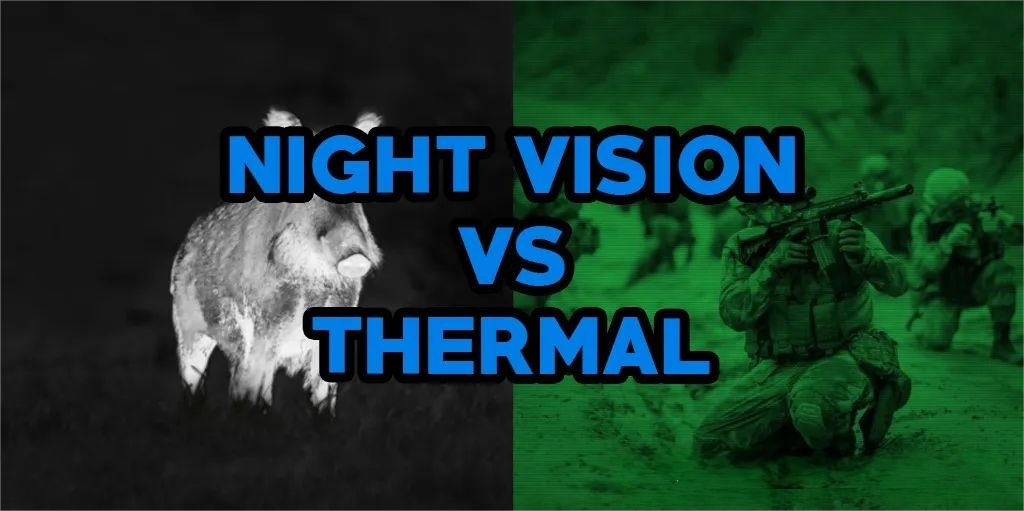
Infrared Night Vision vs. Thermal Imaging: A Comparison and Selection Guide
I. Working Principle and Imaging Characteristics
Infrared Night Vision
· Principle: Forms images by amplifying weak visible light (such as moonlight or starlight) or by actively emitting infrared light.
· Imaging Characteristics: The image is usually green or black and white, requires some ambient light, and cannot penetrate smoke, foliage, or walls.
Thermal Imaging
· Principle: Detects infrared thermal radiation emitted by objects and converts temperature information into a visible image.
· Imaging Characteristics: The image is pseudocolored (such as red, yellow, and blue), does not rely on visible light, and can penetrate smoke, foliage, etc.
II. Applicable Scenarios and Advantages & Disadvantages
Infrared Night Vision
· Applicable Scenarios:
o Military and Security: Night patrols, border surveillance.
o Hunting and Wilderness Exploration: Observing prey or wildlife at night.
o Night Driving: Improving driving safety.
· Advantages: Lower price, clearer image details, suitable for observing visible targets.
· Disadvantages: Requires infrared illumination in complete darkness, greatly affected by light conditions.
Thermal Imaging
· Applicable Scenarios:
o Search and Rescue & Law Enforcement: Finding missing persons or suspects.
o Industrial Inspection: Detecting equipment overheating, building defects.
o Medical Detection: Remote temperature monitoring, skin disease detection.
· Advantages: Usable in complete darkness, penetrates smoke and foliage, unaffected by light.
· Disadvantages: Higher price, image details are not as clear as night vision.
III. How to Choose the Right Device
Night Observation (e.g., Hunting, Wilderness Exploration)
· Infrared night vision is more suitable due to its clearer image details and lower price.
Complete Darkness or Harsh Environments (e.g., Search and Rescue, Industrial Inspection)
· Thermal imaging is more suitable because it does not rely on light and can penetrate obstacles.
Balancing Budget and Needs
· Limited Budget and Need for Clear Details: Choose infrared night vision.
· Sufficient Budget and Need for All-Weather Detection: Choose thermal imaging.
Summary
Infrared night vision is suitable for observing clear targets at night, while thermal imaging is suitable for all-weather detection of concealed targets. Choose based on specific needs and budget.
 Italiano
 English
 Arabic
 French
 Spanish
 Portuguese
 Deutsch
 Turkish
 Dutch
Dutch
 Russian
 Romaian
 Portuguese (Brazil)
 Greek
Greek