


Understanding the Working Principle of Lithium Metal Anode Stacking Machines
Lithium battery stacking machines are critical equipment in the manufacturing of lithium-ion batteries, playing a vital role in various industrial applications. As the demand for renewable energy and high-performance energy storage systems continues to grow, these machines are increasingly important in sectors such as electric vehicle production, portable electronic devices, and energy storage solutions. At Mikrouna, we specialize in providing advanced lithium battery manufacturing equipment, including state-of-the-art stacking machines designed to enhance production efficiency and battery performance.
1. Introduction to Lithium-Ion Batteries
Lithium-ion batteries are rechargeable power sources widely used in modern technology. Their core components include:
- Anode: Typically made from graphite, it stores lithium ions during charging.
- Cathode: Usually composed of lithium metal oxides such as lithium cobalt oxide or lithium iron phosphate (LiFePO4), it releases lithium ions during discharge.
- Electrolyte: A medium that allows ions to move between the anode and cathode.
These components work together to facilitate the storage and release of energy through the movement of lithium ions, making lithium-ion batteries a popular choice for a variety of applications due to their high energy density and long cycle life.
2. Overview of Stacking Machines
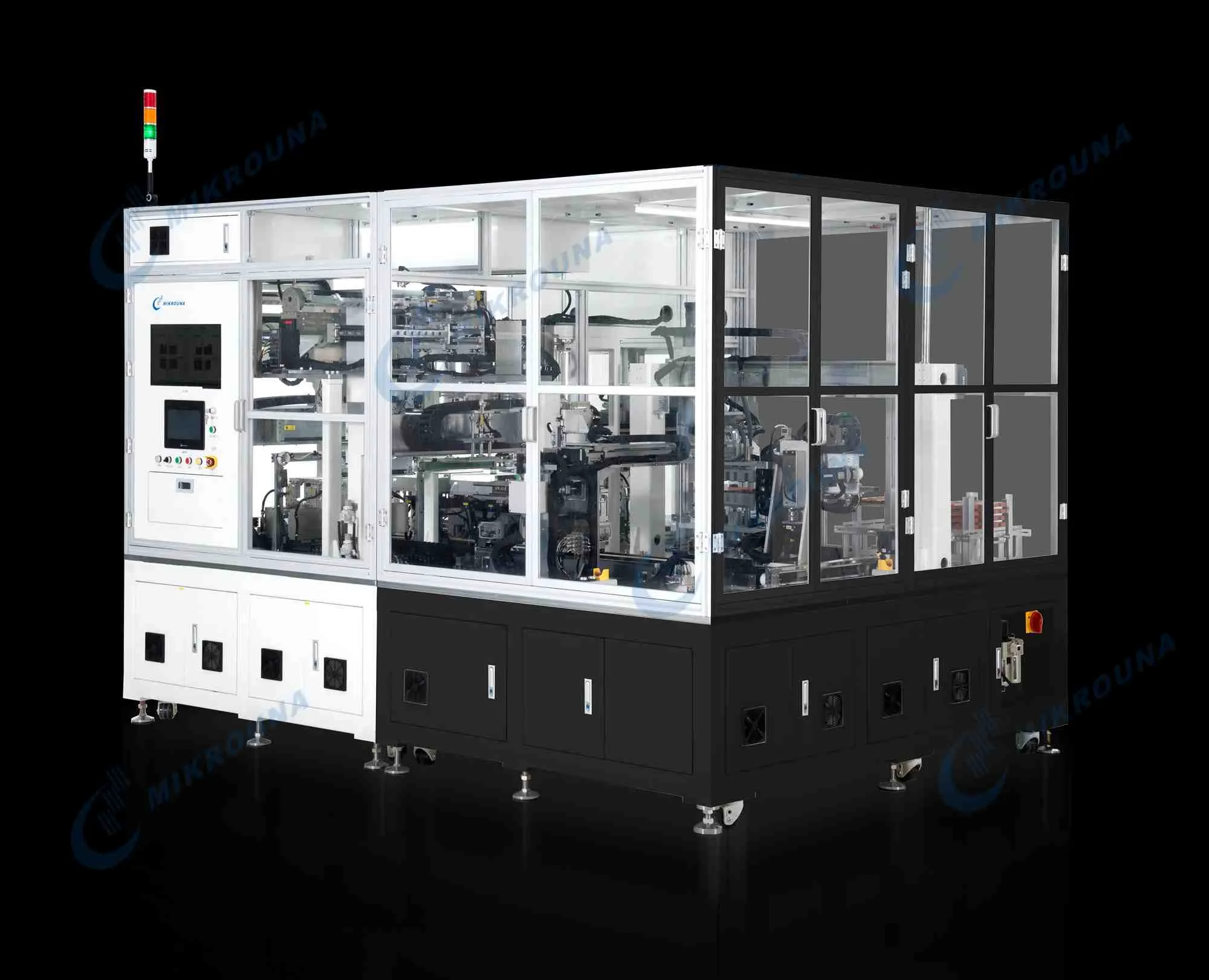
Stacking machines are specialized devices used to produce the components of lithium-ion batteries. In the battery manufacturing process, positive and negative electrode materials must be assembled into tightly packed composite sheets with low porosity. The stacking machine primarily consists of a pressure mechanism, an automatic feeding system, and a control system. Its core function is to layer the electrode materials according to specific patterns and bond them together through pressure.
How Stacking Machines Work
Before operating the stacking machine, the positive and negative electrode materials must be processed and prepared. This involves precise cutting to ensure high-quality battery components. During operation, the stacking machine layers the electrodes together while applying pressure through rollers or plates.
There are various types of stacking machines, including horizontal and vertical configurations:
- Horizontal Stacking Machines: These typically use a rolling mechanism to complete the stacking process. Positive and negative materials enter from different feeding systems and are stacked alternately in a designated area.
- Vertical Stacking Machines: These push materials into molds vertically from two separate feeding systems, gradually layering them to form a complete cell structure.
Regardless of the type, the primary goal is efficient bonding and compression of electrode materials. Proper stacking methods can significantly enhance the energy density of battery components while ensuring stability and longevity.
Advantages:
- High Precision: The Z-type machine employs precise mechanisms to ensure accurate alignment and stacking of electrodes.
- Enhanced Battery Performance: Compared to winding processes, stacking offers higher volumetric energy density—up to 5% more in some designs—while providing greater structural stability.
- Adaptability: The Z-type machine can produce various sizes and shapes of batteries suitable for high-rate applications.
3. Future Trends in Lithium Battery Stacking Technology
As global trends shift towards larger square batteries, the application of stacking technology is expected to expand significantly. The Z-type stacking machine's reliability and efficiency position it well for this transition. Industry forecasts suggest that by 2027, battery production capacity utilizing stacking equipment will reach 845 GWh, corresponding to a market size for stacking machines estimated at approximately 31.9 billion yuan with a compound annual growth rate (CAGR) of 35%.
Conclusion
In summary, lithium battery stacking machines represent significant advancements in battery manufacturing technology. They combine precision, efficiency, and adaptability to meet the growing demands for higher energy densities and safer battery solutions across various industries.
At Mikrouna, we are committed to leading innovation in lithium battery manufacturing equipment. Our advanced Z-type stacking machines are designed to enhance production capabilities while ensuring consistent quality in battery assembly.
For more information about our products or to discuss how Mikrouna can support your lithium battery manufacturing needs, please contact us today! Let us help you drive forward with reliable and efficient energy solutions tailored specifically for your industry requirements.
 French
 English
 Arabic
 Spanish
 Portuguese
 Deutsch
 Turkish
 Dutch
Dutch
 Italiano
 Russian
 Romaian
 Portuguese (Brazil)
 Greek
Greek