


Software Testing Strategies: Building a Smart Quality Framework for Modern Teams
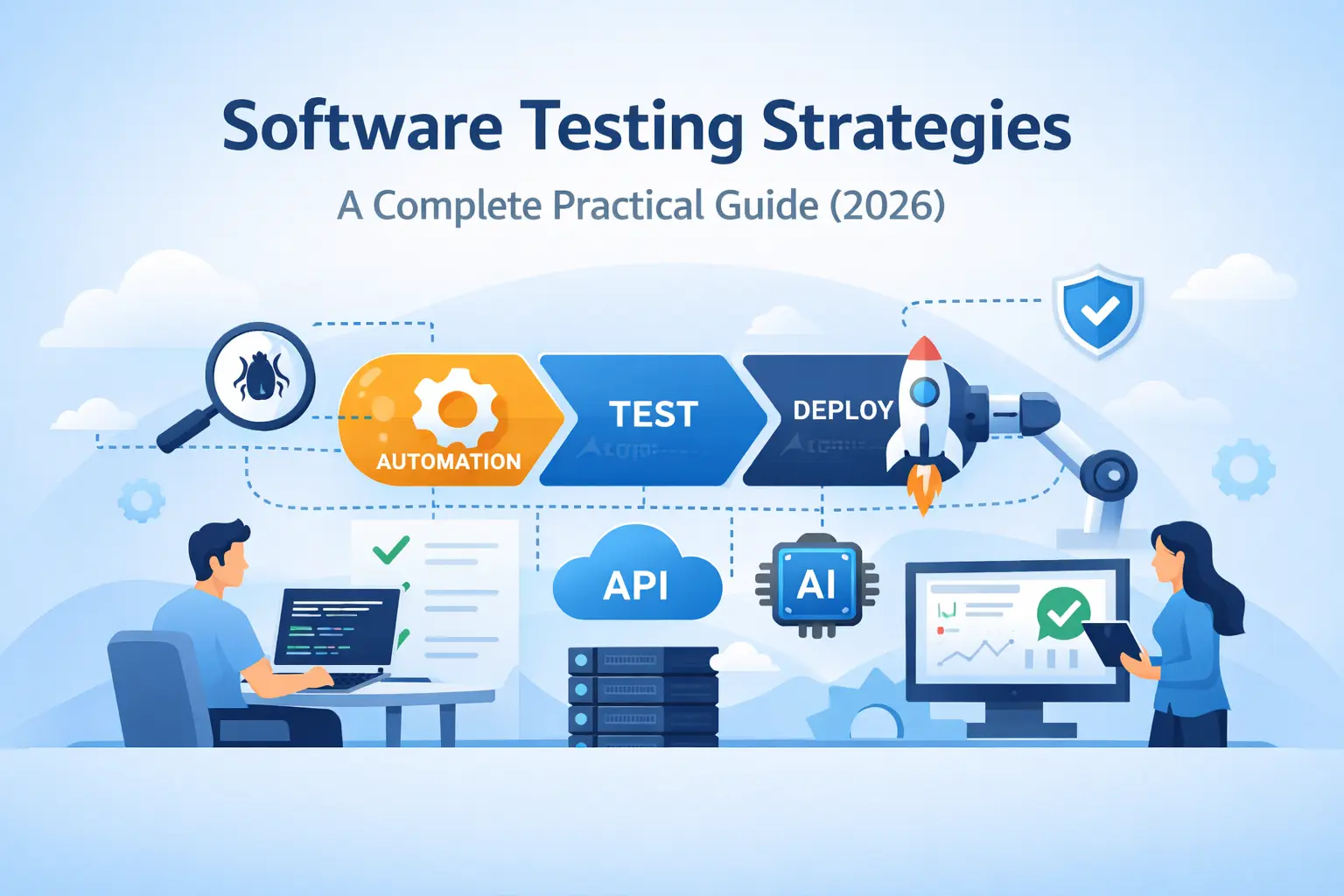
Delivering reliable software in today’s fast-paced development landscape requires more than just writing test cases. It demands structured, scalable, and intelligent software testing strategies that align with business goals, technical architecture, and release cycles.
Whether you're working on a startup product, enterprise SaaS platform, or microservices-based system, a well-defined testing strategy ensures consistent quality, reduced risk, and faster time to market.
Let’s explore how to design and implement effective testing strategies for modern software development.
What Is a Software Testing Strategy?
A software testing strategy is a high-level plan that defines how testing will be approached across the software development lifecycle (SDLC). It outlines:
-
Testing scope and objectives
-
Types of testing to be performed
-
Automation vs manual testing balance
-
Tools and frameworks
-
Risk mitigation approach
-
Metrics and success criteria
Unlike a test plan (which focuses on specific releases), a testing strategy provides long-term direction for maintaining quality.
Why Modern Teams Need Structured Testing Strategies
As applications grow more complex—with APIs, cloud infrastructure, containers, and distributed systems—testing must evolve accordingly.
Without a structured approach, teams may experience:
-
High defect leakage
-
Slow regression cycles
-
Flaky automation tests
-
Inconsistent quality standards
-
Production outages
Well-designed software testing strategies help teams:
-
Detect defects earlier
-
Improve automation efficiency
-
Minimize regression risks
-
Enhance collaboration between developers and QA
-
Maintain release confidence
In DevOps and CI/CD environments, testing must be continuous, automated, and data-driven.
Core Software Testing Strategies
1. Preventive Testing Strategy
Preventive testing focuses on avoiding defects rather than detecting them later. It emphasizes:
-
Requirement validation
-
Code reviews
-
Static code analysis
-
Early design verification
This approach reduces downstream costs since fixing bugs earlier is significantly cheaper than post-release fixes.
Best for:
-
Enterprise systems
-
Safety-critical applications
-
Financial platforms
2. Reactive Testing Strategy
Reactive testing begins after the software is developed. It focuses on executing test cases and identifying issues during later stages.
This approach is common in traditional waterfall models but is less effective for fast-paced agile teams.
Best for:
-
Legacy systems
-
Fixed-scope projects
3. Risk-Based Testing Strategy
Risk-based testing prioritizes test cases based on:
-
Business impact
-
Failure probability
-
Security exposure
-
User traffic areas
High-risk modules receive more testing attention, ensuring optimal use of time and resources.
Benefits:
-
Faster test cycles
-
Efficient resource allocation
-
Better ROI on testing
4. Automation-First Strategy
Modern applications require frequent releases. An automation-first strategy ensures:
-
Unit tests for every feature
-
Automated integration testing
-
Continuous regression testing
-
CI/CD pipeline integration
Automation reduces human error and enables rapid scaling of testing processes.
Best for:
-
SaaS companies
-
Agile teams
-
Microservices architecture
5. Shift-Left Testing Strategy
Shift-left testing integrates testing earlier in the development lifecycle. Developers participate actively in testing through:
-
Test-driven development (TDD)
-
Behavior-driven development (BDD)
-
Continuous testing pipelines
Advantages:
-
Early defect detection
-
Faster feedback loops
-
Reduced rework costs
This strategy aligns strongly with DevOps culture.
6. End-to-End Testing Strategy
End-to-end testing validates the complete user journey from start to finish.
It ensures:
-
System workflows function correctly
-
External integrations work seamlessly
-
Real-world scenarios are validated
However, E2E tests should be optimized since they are often slower and harder to maintain.
Key Components of Effective Software Testing Strategies
1. Balanced Test Pyramid
A strong strategy follows the test pyramid model:
-
Large base of unit tests
-
Moderate number of integration tests
-
Fewer end-to-end tests
This ensures faster execution and easier maintenance.
2. Continuous Integration Support
Integrating testing with CI tools ensures that:
-
Every code commit is validated
-
Failures are detected instantly
-
Quality gates prevent faulty releases
3. Clear Quality Metrics
Track measurable KPIs such as:
-
Test coverage percentage
-
Defect density
-
Escaped defects
-
Mean time to detect (MTTD)
-
Mean time to resolve (MTTR)
Metrics help teams continuously improve their strategy.
4. Scalability Planning
Your testing strategy must scale as your product grows. This includes:
-
Parallel test execution
-
Cloud-based testing infrastructure
-
Distributed environment testing
Common Challenges in Testing Strategy Implementation
Even with strong planning, teams often struggle with:
-
Over-automation without strategy
-
Poor test maintenance
-
Flaky test suites
-
Lack of documentation
-
Misalignment between dev and QA teams
To overcome these challenges, organizations must promote collaboration, automation discipline, and continuous improvement.
Testing Strategies in Microservices & API-Based Systems
Modern backend systems are API-driven and distributed. This requires:
-
Strong integration testing
-
Contract testing
-
API regression testing
-
Mocking external dependencies
Microservices demand highly automated testing workflows to ensure service reliability and inter-service communication integrity.
How to Design the Right Testing Strategy
Follow these steps:
-
Analyze application architecture
-
Identify high-risk areas
-
Define automation goals
-
Choose appropriate tools
-
Integrate with CI/CD pipelines
-
Monitor metrics and iterate
Remember: No single strategy fits all projects. The best approach is a hybrid model tailored to your team’s workflow.
The Future of Software Testing Strategies
The evolution of software testing includes:
-
AI-driven test generation
-
Predictive defect analytics
-
Self-healing automation
-
Autonomous testing pipelines
Quality engineering is replacing traditional QA, focusing on building quality throughout the development lifecycle rather than testing at the end.
Conclusion
Effective software testing strategies are essential for delivering reliable, scalable, and high-performing applications. From shift-left and automation-first approaches to risk-based and end-to-end strategies, each method contributes to building a strong quality foundation.
Organizations that invest in structured, scalable testing strategies gain:
-
Faster releases
-
Lower defect rates
-
Reduced maintenance costs
-
Higher customer satisfaction
In today’s competitive software landscape, testing strategy is not just a QA activity — it’s a business advantage.
 Spanish
 English
 Arabic
 French
 Portuguese
 Deutsch
 Turkish
 Dutch
Dutch
 Italiano
 Russian
 Romaian
 Portuguese (Brazil)
 Greek
Greek