


Small Language Models 2026
Picture this: a startup founder in Austin grabs the booth across from me, laptop plastered with stickers, looking exhausted. "We built something users rave about," she says, "but the AI bills are killing us, and shipping customer data to the cloud feels like playing Russian roulette with privacy."
I hear versions of this story everywhere—from Miami cafes to Minneapolis boardrooms. The truth hitting businesses hard in 2026: those gigantic frontier models everyone chased? They're massive overkill for 80-90% of real problems.
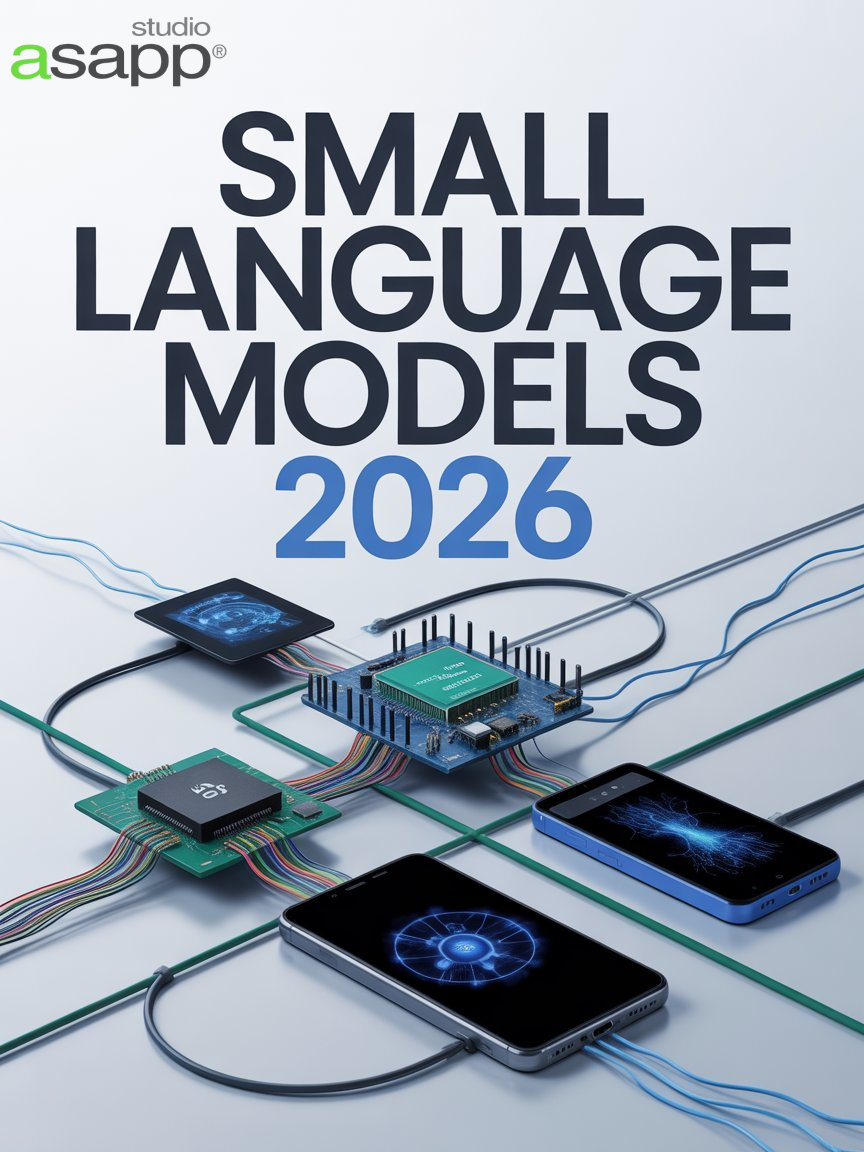
Enter the small language model (SLM) era. Compact, fast, affordable AI that runs on your existing devices, keeps data local, and delivers results without the drama. What felt futuristic in 2024 is standard practice now.
What Exactly Is a Small Language Model?
Forget the idea of SLMs as "dumbed-down" versions of giants like GPT-4 or Claude. They're not mini-me copies.
SLMs typically range from a few hundred million to around 8-10 billion parameters—tiny compared to the 100B+ behemoths. But size isn't the story. These models are engineered for efficiency: blazing inference speed, on-device or edge deployment, and specialization that often beats generalists on targeted tasks.
In 2026, when every company needs reliable AI without insane costs or privacy risks, this focus wins.
SLMs vs. Large Language Models: The Practical Breakdown
It's not size vs. size—it's fit for purpose.
Large models (LLMs):
- Cloud-bound, hungry for massive infrastructure
- Handle almost anything (with trade-offs in latency/cost)
- Useless offline
- Expensive at scale
- Data leaves your control
Small models (SLMs):
- Run locally—phones, laptops, edge servers
- Excel at specific domains
- Fully offline-capable
- Often 5-20% of cloud costs
- Data stays put (huge for regulated industries)
Right tool, right job. No more using a rocket launcher to crack a walnut.
Real-World SLM Examples Leading the Charge
Microsoft's Phi Series Phi models keep redefining what's possible at small scale. Phi-3.5 (and the newer Phi-4 family) delivers exceptional reasoning and multilingual performance in compact packages. A legal team I know runs contract analysis locally on standard laptops—zero cloud, full confidentiality, lightning fast.
Google's Gemma Family Gemma 2/3 variants shine for on-device and edge use. Strong in multilingual tasks, STEM reasoning, and efficiency. Mobile devs embed them for offline features that feel native.
Meta's Llama Series Llama 3.1/3.2/4 Scout iterations (especially the 8B-class models) remain open-source favorites. Flexible, strong instruction-following, great for everything from code assistance to customer support. Manufacturing crews use them on rugged tablets for real-time troubleshooting—no internet needed.
Other Standouts
- Qwen3 series (Alibaba): Tiny powerhouses like 0.6B-8B versions crush reasoning and multilingual benchmarks.
- Mistral/Ministral updates: Excellent efficiency and domain adaptability.
These aren't hypotheticals—they're deployed at scale today.
Why SLMs Are Winning in 2026: Core Advantages
Speed Local inference means milliseconds, not seconds. Real-time chat, code completion, or decision-making feels instant—no network roulette.
Privacy & Security Data never leaves. Essential for healthcare (HIPAA), finance, legal, government. No "trust us" cloud promises.
Cost Savings One client slashed monthly AI spend from $12K+ to ~$400 by handling routine queries locally. That math scales across industries.
Offline Reliability Field workers, rural clinics, remote ops—AI works where connectivity doesn't.
The Agentic Future Belongs to SLMs AI agents need rapid, cheap, specialized decisions. SLMs deliver: low latency for real-time loops, negligible run costs for 24/7 operation, and domain-tuned accuracy that generalists can't match consistently.
Logistics firms now run route-optimizing agents locally, cutting delays significantly—all without cloud bills.
Top SLMs to Watch in February 2026
General-purpose/open-source leaders:
- Microsoft Phi-4 / Phi-3.5 family — Reasoning kings at small scale
- Google Gemma 3 — Multimodal, multilingual edge champ
- Meta Llama 4 Scout / Llama 3.1 8B — Consistent, deploy-anywhere winner
- Qwen3 variants (0.6B–8B) — Lightweight beasts for reasoning/agent tasks
Domain stars:
- Coding: Llama-based Code models, StarCoder2 successors
- Healthcare/legal: Fine-tuned Phi/Qwen variants
- Mobile/edge: Gemma, Phi-4-mini
Test for your use case—leaderboards shift fast, but specialization + efficiency wins.
How to Get Started with SLMs Today
- Pinpoint the problem: Repetitive, domain-specific tasks scream for SLMs.
- Pick a base: Start with open Phi/Gemma/Llama, fine-tune via distillation/transfer learning on your data.
- Deploy smart: ONNX/TensorFlow Lite for mobile, PyTorch/ONNX for edge/servers.
- Pilot ruthlessly: Measure speed, accuracy, cost, privacy wins.
- Scale + maintain: Budget for iteration as needs evolve.
Small teams ship production SLM solutions in weeks to months—not years.
The Bottom Line
2026 is the year efficiency took over. SLMs aren't replacing massive models—they're replacing bad fits. For most business value—speed, cost, privacy, reliability—the compact path delivers more with less.
While others debate parameter counts, forward-thinking teams deploy focused, local AI that solves real problems without new headaches.
The compact revolution isn't coming. It's here.
(If you're exploring SLM implementations for your business—whether mobile apps, web platforms, or process automation—I'm happy to chat specifics. The tech's proven; the question is how it fits your world.)
Quick FAQ
What defines an SLM? Typically <10B parameters, optimized for local/edge runtimes, task specialization, efficiency.
SLMs vs LLMs? SLMs win on speed/privacy/cost/offline; LLMs on broad zero-shot generality.
Mobile-friendly? Absolutely—many run on phones/tablets today, enabling true offline AI.
Business-ready? Yes, especially for targeted applications in support, analysis, compliance-heavy fields.
The future isn't biggest—it's smartest deployment.

 Romaian
 English
 Arabic
 French
 Spanish
 Portuguese
 Deutsch
 Turkish
 Dutch
Dutch
 Italiano
 Russian
 Portuguese (Brazil)
 Greek
Greek