


How Smart Contracts Are Influencing DeFi, NFTs, and Beyond
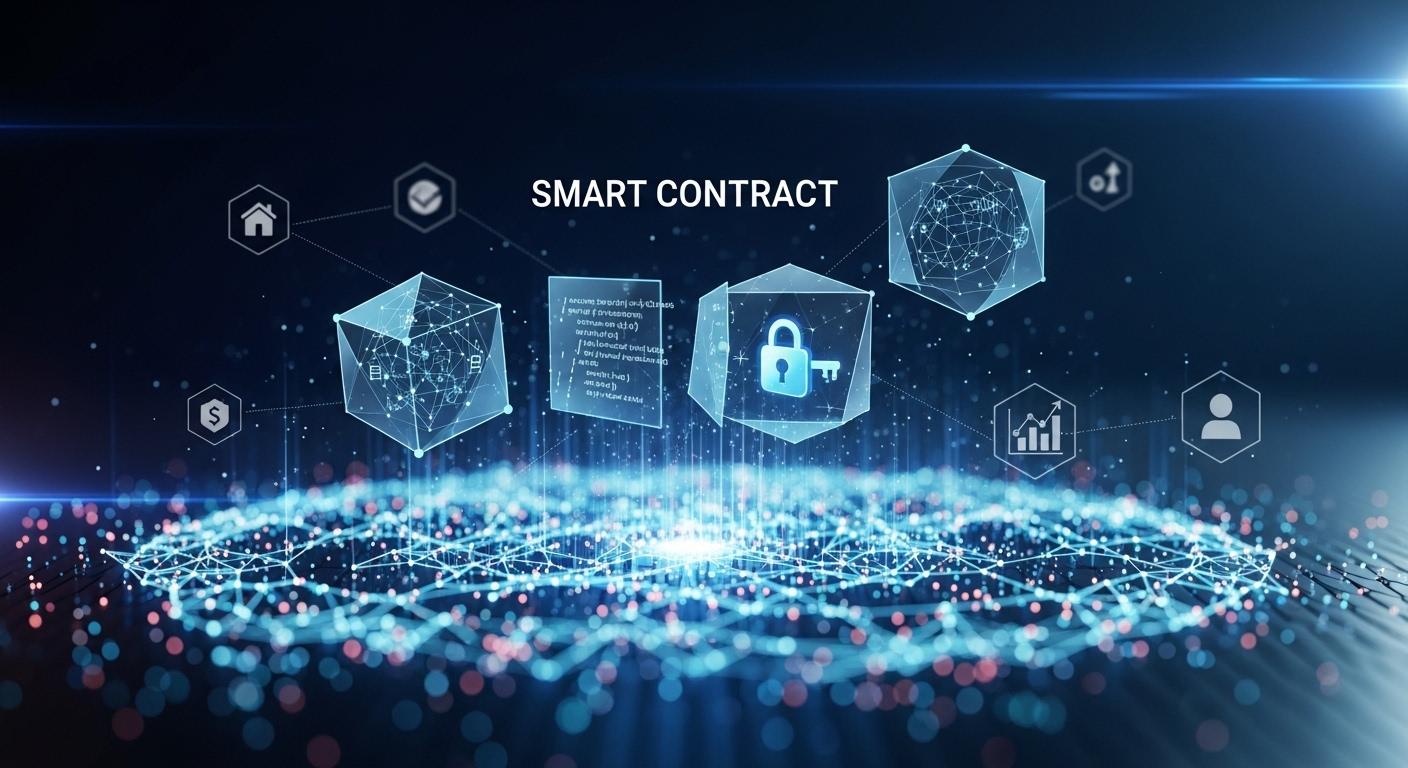
Smart contracts have emerged as one of the most consequential innovations in blockchain technology, fundamentally reshaping how digital value is created, exchanged, and governed. What began as a technical mechanism for automating simple agreements has evolved into the core infrastructure powering decentralized finance (DeFi), non-fungible tokens (NFTs), and a rapidly expanding universe of Web3 applications. Today, smart contracts are not merely supporting these ecosystems they are actively redefining how entire digital economies function.
This influence extends far beyond crypto-native experimentation. As industries explore decentralized models for finance, ownership, governance, and automation, smart contracts are becoming the connective tissue linking trustless execution with real-world business logic. Understanding their role across DeFi, NFTs, and emerging sectors is essential to understanding the future of blockchain itself.
Smart Contracts as the Foundation of Decentralized Systems
At their core, smart contracts are self-executing programs deployed on blockchain networks that automatically enforce predefined rules. Once deployed, they operate without intermediaries, relying on blockchain consensus to guarantee integrity and transparency. This simple premise has profound implications.
Traditional digital systems depend on centralized authorities to validate transactions, enforce rules, and resolve disputes. Smart contracts replace these authorities with code. In doing so, they eliminate single points of failure and reduce the need for trust in institutions. This shift is what enables decentralized systems to scale globally while remaining open and permissionless.
As blockchain ecosystems matured, smart contract development moved from isolated scripts to interconnected systems that manage assets, incentives, and governance. This evolution laid the groundwork for DeFi, NFTs, and the broader Web3 movement.
Transforming Finance Through Smart Contracts in DeFi
Decentralized finance represents the most direct and measurable impact of smart contracts to date. DeFi protocols use smart contracts to recreate and in many cases improve upon traditional financial services such as lending, trading, derivatives, and asset management.
In lending protocols, smart contracts automatically manage deposits, collateralization, interest calculations, and liquidations. Borrowers and lenders interact directly with code, not banks. This removes geographic barriers and enables 24/7 financial services without intermediaries. According to industry data, DeFi platforms at their peak secured tens of billions of dollars in total value locked, all governed by smart contract logic.
Decentralized exchanges rely entirely on smart contracts to execute trades, manage liquidity pools, and price assets algorithmically. Automated market makers replaced traditional order books with on-chain mathematical models, creating new forms of liquidity provision and yield generation.
These innovations are possible only because smart contracts can reliably enforce complex financial rules at scale. As a result, Smart Contract Development has become synonymous with DeFi innovation, with security, efficiency, and composability serving as core design priorities.
NFTs and the Programmable Ownership Revolution
While DeFi reshaped financial infrastructure, NFTs redefined digital ownership and smart contracts made this possible. Unlike traditional digital assets, NFTs derive their uniqueness, transferability, and usage rights from smart contract logic rather than centralized databases.
Smart contracts govern how NFTs are minted, transferred, and monetized. They can encode royalty mechanisms that automatically pay creators whenever an asset is resold, fundamentally altering the economics of digital content. This feature alone has attracted artists, musicians, and brands seeking fairer distribution models.
In gaming and virtual worlds, NFTs represent in-game assets whose ownership persists beyond any single platform. Smart contracts ensure that these assets remain verifiable and transferable, enabling interoperable digital economies.
As NFTs evolve beyond collectibles into identity credentials, access passes, and financial instruments, smart contract development services play a critical role in ensuring scalability, interoperability, and security across platforms.
The Role of Smart Contracts in DAO Governance
Beyond finance and ownership, smart contracts are redefining how organizations operate. Decentralized Autonomous Organizations (DAOs) use smart contracts to manage governance, treasury operations, and decision-making without centralized leadership.
Voting mechanisms, proposal execution, and fund allocation are all handled through smart contracts. This creates transparent, tamper-resistant governance systems where rules are enforced automatically. Unlike traditional organizations, DAOs can operate globally without legal incorporation, relying on code as the ultimate authority.
This model has been adopted by investment collectives, protocol governance bodies, and even social communities. Smart contracts enable these organizations to scale coordination without sacrificing transparency or accountability.
As DAOs grow more sophisticated, smart contract development increasingly overlaps with organizational design, blending economics, governance theory, and software engineering into a single discipline.
Beyond DeFi and NFTs: Expanding Real-World Applications
The influence of smart contracts now extends well beyond DeFi and NFTs. Enterprises and governments are exploring blockchain automation to streamline operations, reduce fraud, and improve transparency.
In supply chain management, smart contracts track goods, verify authenticity, and automate payments once delivery conditions are met. This reduces disputes and enhances trust among global partners. In insurance, smart contracts enable parametric policies that trigger payouts automatically based on verified data, eliminating lengthy claims processes.
In intellectual property and licensing, smart contracts manage usage rights and revenue distribution without intermediaries. Even in healthcare and identity management, blockchain-based automation is being explored to secure sensitive data while maintaining user control.
These applications highlight a broader trend: smart contracts are evolving from crypto-native tools into general-purpose automation infrastructure. Businesses entering this space increasingly rely on experienced smart contract development companies to navigate technical and regulatory complexity.
Security and Reliability as Growth Catalysts
As smart contracts influence more value-driven systems, security has become a central concern. Early exploits exposed vulnerabilities in poorly designed contracts, leading to significant financial losses. These incidents underscored a key reality: smart contracts are unforgiving. Once deployed, mistakes are often irreversible.
In response, development practices have matured significantly. Formal verification, automated testing, and continuous auditing are now common in professional smart contract development services. Modular architectures and upgrade mechanisms allow systems to evolve while preserving trust.
This focus on security has been instrumental in expanding smart contract adoption. Enterprises and institutional users are far more likely to engage with decentralized systems when the underlying contracts meet rigorous standards.
Interoperability and the Composability Effect
One of the most powerful aspects of smart contracts is composability the ability for applications to interact and build on one another. DeFi protocols integrate seamlessly, NFTs move across platforms, and DAOs coordinate with external services, all through standardized smart contract interfaces.
This composability accelerates innovation. Developers can build new products by combining existing smart contracts rather than starting from scratch. Entire ecosystems emerge from these interactions, with smart contracts acting as shared infrastructure.
As cross-chain technologies mature, smart contracts increasingly operate across multiple blockchains, further expanding their reach. This interoperability reinforces their role as the backbone of decentralized systems.
The Strategic Role of Smart Contract Development Companies
Given their central importance, smart contracts require expertise that extends beyond basic programming. Smart contract development companies bring specialized knowledge in security, scalability, and economic modeling, helping projects move from concept to production.
For startups, these companies reduce time-to-market and mitigate technical risk. For enterprises, they ensure that blockchain initiatives align with compliance requirements and operational standards. In both cases, professional smart contract development services are essential for building systems that can scale sustainably.
As demand grows, the quality of smart contract development increasingly differentiates successful projects from those that fail.
The Future Impact of Smart Contracts
Looking ahead, smart contracts are poised to influence even broader domains. Integration with artificial intelligence, real-world data feeds, and decentralized identity systems will enable more adaptive and intelligent automation.
Regulatory clarity is also improving, allowing businesses to deploy smart contracts with greater confidence. As tooling becomes more accessible, smart contract development will increasingly resemble traditional software engineering—while retaining its decentralized foundations.
What remains constant is their role as enablers of trustless, programmable systems. Whether in finance, digital ownership, governance, or enterprise automation, smart contracts are shaping how value flows in the digital age.
Conclusion
Smart contracts have moved beyond their origins as niche blockchain tools to become the driving force behind DeFi, NFTs, and the expanding Web3 ecosystem. By enabling automation, transparency, and decentralized trust, they have redefined finance, ownership, and organizational structures.
Their influence continues to grow as industries explore new ways to leverage blockchain technology. High-quality Smart Contract Development, supported by experienced smart contract development services and a capable smart contract development company, is now a prerequisite for building resilient, future-ready decentralized systems.
 Italiano
 English
 Arabic
 French
 Spanish
 Portuguese
 Deutsch
 Turkish
 Dutch
Dutch
 Russian
 Romaian
 Portuguese (Brazil)
 Greek
Greek