


AI Prompt Playbook for Modern HR Teams
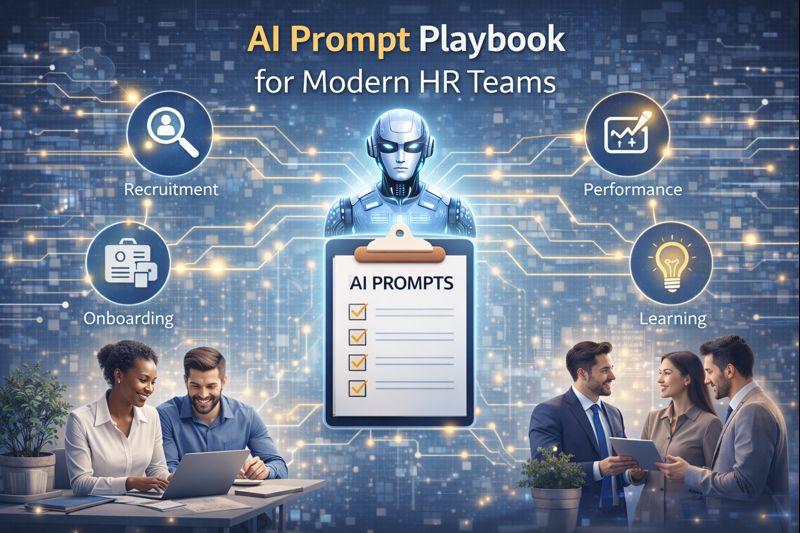
HR teams are expected to deliver faster results, better employee experiences, and data-driven insights often with limited resources. While AI tools are becoming increasingly common in HR, their true value lies in how effectively they are used. This is where AI prompts make a difference.
A well-crafted prompt turns AI into a reliable HR assistant, helping teams automate routine tasks, improve consistency, and focus on strategic work. This playbook outlines practical ways HR teams can use AI prompts to work smarter every day.
Why AI Prompts Matter for HR
AI tools respond directly to the clarity and context of a prompt. Vague instructions result in generic output, while HR-specific prompts produce accurate, usable content.
Effective AI prompts help HR teams:
- Reduce manual, repetitive work
- Maintain consistent tone and policy alignment
- Improve turnaround times
- Support better decision-making
Prompts act as the bridge between AI capability and real HR value.
Key HR Use Cases and Sample Prompts
Recruitment and Talent Acquisition
AI prompts can significantly speed up hiring-related tasks.
Example Prompts:
- “Create a skills-based job description for a [role] in the [industry], focusing on core competencies and growth opportunities.”
- “Summarize this resume and highlight strengths, gaps, and role fit for a [job title].”
- “Generate structured interview questions aligned with technical and behavioral competencies.”
Onboarding and Employee Communication
Consistency and clarity are critical during onboarding.
Example Prompts:
- “Draft a welcoming onboarding email for a new employee joining as a [role].”
- “Create a 30-60-90 day onboarding plan for a new hire in [department].”
- “Rewrite this HR policy update in simple, employee-friendly language.”
Performance Management and Feedback
AI prompts help structure feedback and reviews effectively.
Example Prompts:
- “Create a performance review summary based on these achievements and goals.”
- “Generate constructive feedback focused on professional development.”
- “Suggest measurable performance goals aligned with team objectives.”
Learning and Development
AI can support continuous learning initiatives.
Example Prompts:
- “Design a learning roadmap for employees to build skills in [area].”
- “Recommend training programs based on current skill gaps for a [role].”
- “Create microlearning content for compliance training.”
HR Operations and Policy Support
AI prompts simplify documentation and employee support.
Example Prompts:
- “Summarize this HR policy into a one-page employee overview.”
- “Create an FAQ for employees about [policy or benefit].”
- “Draft a professional HR response to an employee inquiry.”
Best Practices for Using AI Prompts in HR
To ensure accuracy and compliance, HR teams should:
- Be specific about context, tone, and audience
- Avoid sharing sensitive or personal employee data
- Review and refine AI-generated outputs
- Align content with company policies and values
AI should support HR expertise not replace human judgment.
The Impact on HR Efficiency
By integrating AI prompts into daily workflows, HR teams can dramatically reduce manual effort and turnaround time. This enables HR professionals to focus on strategic priorities such as talent development, engagement, and workforce planning.
HR tech is evolving fast. Are you keeping up? Read more at HR Technology Insights
To participate in our interviews, please write to our HRTech Media Room at info@intentamplify.com
 Italiano
 English
 Arabic
 French
 Spanish
 Portuguese
 Deutsch
 Turkish
 Dutch
Dutch
 Russian
 Romaian
 Portuguese (Brazil)
 Greek
Greek