


Smart Rooftop HVAC Units Market
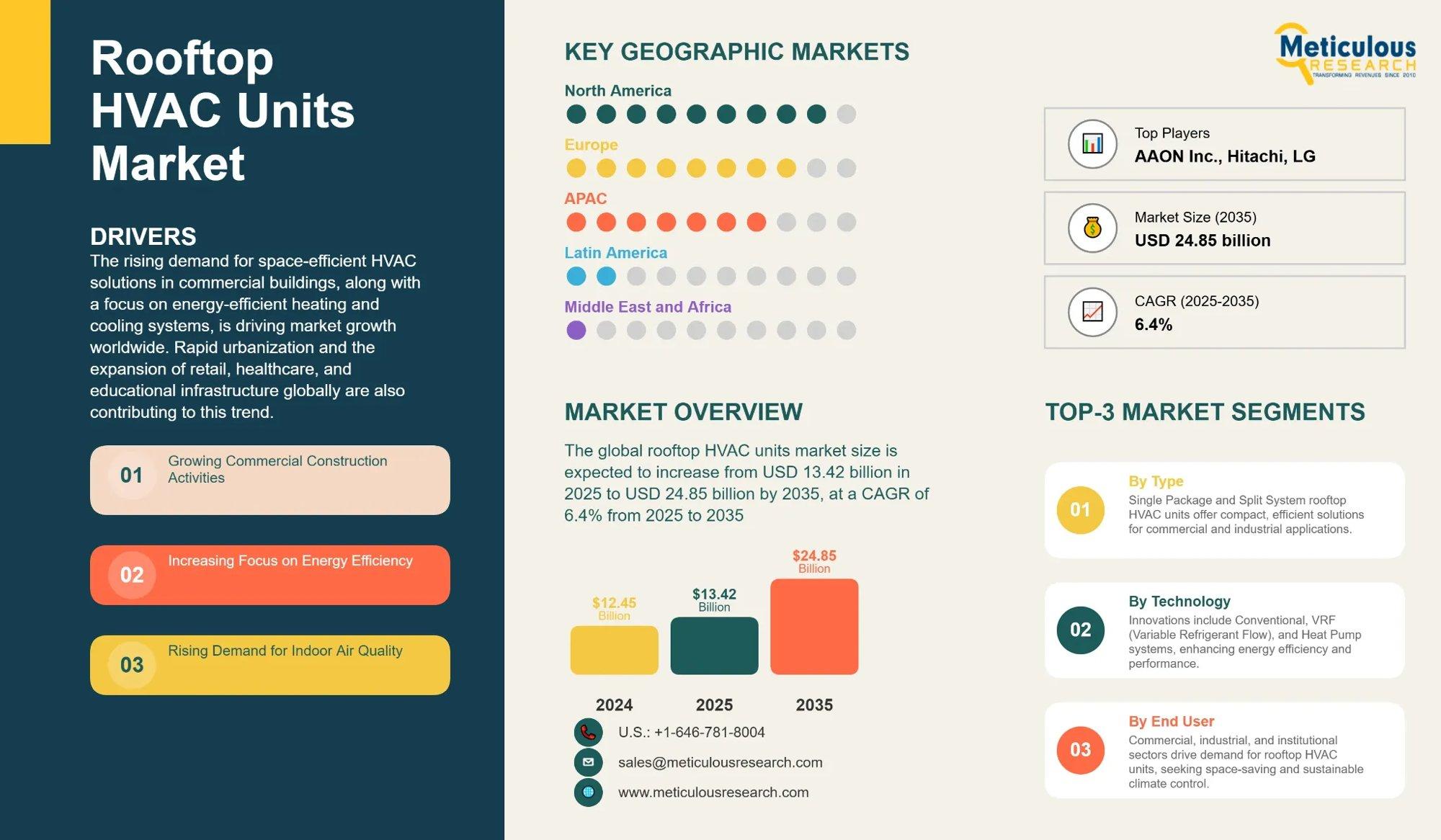
According to this latest publication from Meticulous Research®, the global rooftop HVAC units market is witnessing steady growth as commercial and industrial buildings increasingly adopt space-efficient and energy-efficient heating, ventilation, and air conditioning solutions. The market was valued at USD 12.45 billion in 2024 and is projected to grow from USD 13.42 billion in 2025 to USD 24.85 billion by 2035, registering a compound annual growth rate (CAGR) of 6.4% during the forecast period. Market growth is primarily driven by rapid urbanization, rising investments in commercial infrastructure, and increasing emphasis on energy-efficient building systems across both developed and emerging economies.
What Are Rooftop HVAC Units
Rooftop HVAC units are self-contained heating, ventilation, and air conditioning systems installed on building rooftops to serve commercial and industrial spaces. These units integrate compressors, condensers, evaporators, fans, and control systems within weather-resistant enclosures, eliminating the need for indoor mechanical rooms and maximizing usable floor space. Compared to traditional split HVAC systems, rooftop units offer simplified installation, centralized maintenance access, reduced indoor noise levels, and flexible zoning options, making them a preferred solution for retail stores, offices, healthcare facilities, educational institutions, warehouses, and industrial buildings.
Key Market Drivers and Technology Trends
The rising need to optimize building space and improve indoor air quality is driving widespread adoption of rooftop HVAC units. Advancements in smart controls, variable refrigerant flow (VRF) technology, eco-friendly refrigerants, and high-efficiency compressors are improving system performance and reducing operating costs. Additionally, replacement of aging rooftop units—many of which have exceeded 15 to 20 years of service life—is creating strong aftermarket demand, particularly in North America and Europe.
Artificial intelligence is transforming the market by enabling predictive maintenance, intelligent energy optimization, and automated climate control. AI-powered systems analyze real-time operating data, weather conditions, and occupancy patterns to optimize performance. Machine learning algorithms help detect faults early, reduce downtime, and extend equipment lifespan, while AI-based load balancing can reduce energy consumption by 20–30%.
Integration with building automation systems (BAS) and IoT platforms is another major trend. Modern rooftop units support protocols like BACnet and Modbus, enabling centralized monitoring and data-driven decision-making. The growing adoption of heat pump and VRF-based rooftop systems is also significant, as these technologies provide superior energy efficiency and support electrification goals by reducing reliance on fossil fuels.
Market Segmentation Highlights
The rooftop HVAC units market shows distinct segmentation patterns. Single package units dominate by type, accounting for nearly 75% of global market share in 2025, valued for their compact design and cost-effectiveness. By capacity, the 10–30 tons segment leads with 45–50% market share. Conventional rooftop units hold the largest share at 50–55% by technology, while heat pump rooftop units are expected to witness the fastest growth. The commercial segment represents approximately 70% of total demand, driven by retail, office, healthcare, and educational facilities.
Regional Market Insights
North America dominates the global rooftop HVAC units market, accounting for approximately 42% market share in 2025, benefiting from widespread use of rooftop units as the standard HVAC solution for low-rise commercial buildings, a strong replacement market, and strict energy efficiency regulations like ASHRAE 90.1 and Title 24. Asia Pacific is expected to register the fastest CAGR during the forecast period, supported by rapid urban development, expanding commercial infrastructure, and government initiatives promoting energy-efficient buildings in countries like China and India.
Competitive Landscape and Future Outlook
The market features a mix of global HVAC manufacturers and regional players focused on innovation and digital integration. Leading companies include Trane Technologies plc, Carrier Global Corporation, Johnson Controls International plc, Daikin Industries Ltd., Lennox International Inc., and Mitsubishi Electric Corporation. As commercial construction activity expands and building owners prioritize energy efficiency and sustainability, rooftop HVAC units are expected to remain a core component of modern building infrastructure, with strong demand ensuring consistent growth through 2035.
Download sample report here : https://www.meticulousresearch.com/download-sample-report/cp_id=6280
Contact Us:
Meticulous Research®
Email- sales@meticulousresearch.com
Contact Sales- +1-646-781-8004
Connect with us on LinkedIn- https://www.linkedin.com/company/meticulous-research
 Portuguese
 English
 Arabic
 French
 Spanish
 Deutsch
 Turkish
 Dutch
Dutch
 Italiano
 Russian
 Romaian
 Portuguese (Brazil)
 Greek
Greek