


Understanding IT Service Dependencies
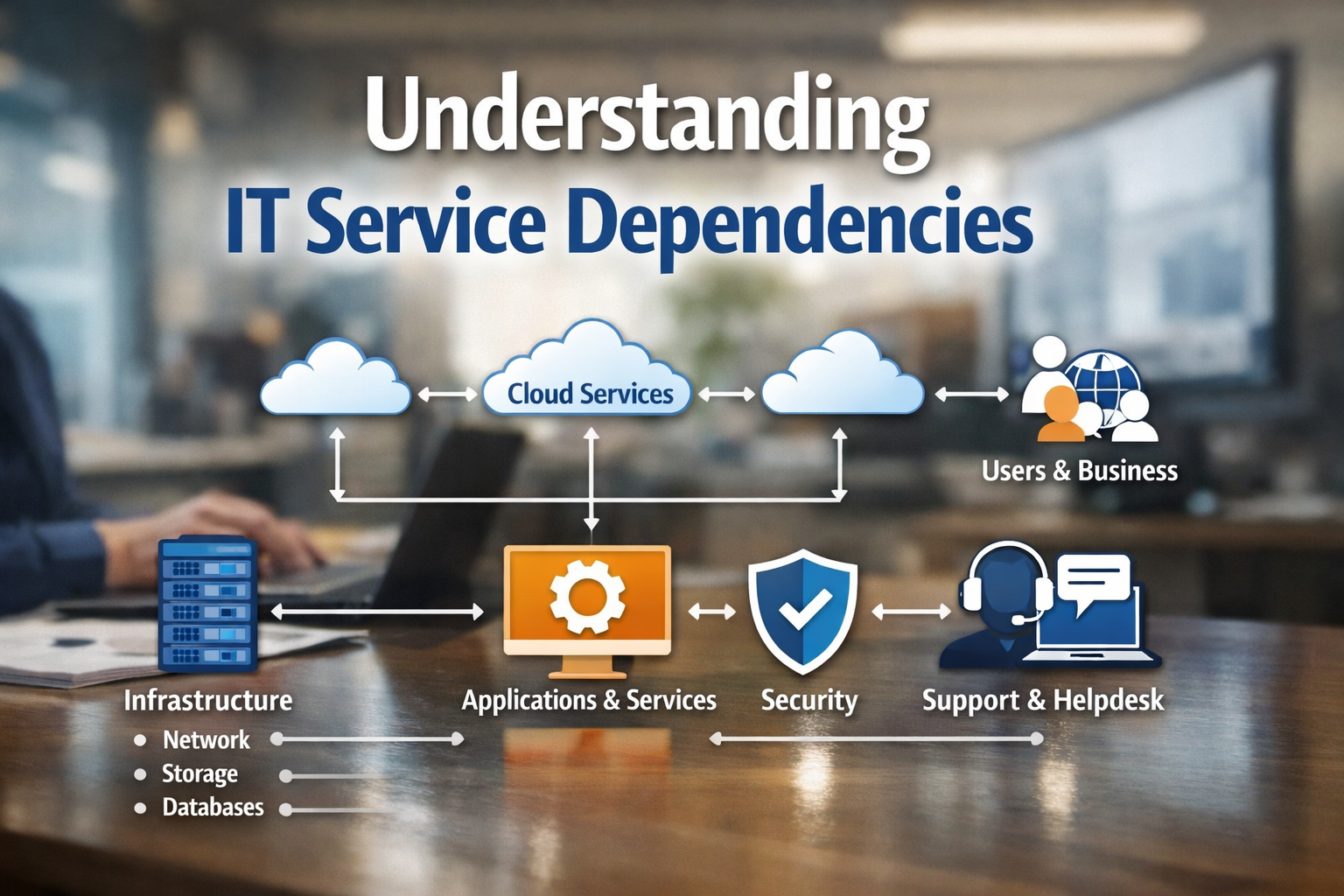
In today’s interconnected IT environments, no service works in isolation. Applications rely on infrastructure, networks depend on security controls, and business processes are tightly linked to multiple IT components. This is where IT service dependencies come into play. Understanding these dependencies is essential for delivering stable, reliable, and value-driven IT services—especially for professionals preparing for the ITIL 4 Foundation and broader ITIL Certification journey.
What Are IT Service Dependencies?
IT service dependencies refer to the relationships between different IT services, components, teams, and suppliers that collectively enable a business service to function. For example, an online banking service depends on databases, application servers, network connectivity, identity management, and third-party payment gateways. A failure in any one of these can disrupt the entire service.
Recognizing these dependencies helps IT teams understand how changes, incidents, or improvements in one area can impact others.
Why Understanding Dependencies Matters
-
Improved Incident Management
When an incident occurs, knowing service dependencies allows teams to quickly identify the root cause. Instead of treating symptoms, IT can focus on the underlying component affecting multiple services. This is a key theme in many ITIL Interview Questions, where candidates are asked how to reduce downtime and restore services faster. -
Better Change and Risk Management
Changes made without understanding dependencies often lead to unexpected outages. Mapping dependencies enables risk assessment before implementing changes, aligning perfectly with ITIL’s focus on value co-creation and risk reduction. -
Stronger Service Continuity
For business-critical services, dependency awareness is vital for continuity planning. Backup systems, failover mechanisms, and supplier arrangements must all be aligned to ensure resilience during disruptions.
ITIL 4 Perspective on Service Dependencies
In ITIL 4 Foundation, service dependencies are viewed through the lens of the Service Value System (SVS) and service relationships. ITIL 4 emphasizes collaboration across value streams, where multiple practices—such as incident management, problem management, and service configuration management—work together.
The Service Configuration Management practice plays a crucial role here by maintaining information about configuration items (CIs) and their relationships. This visibility helps organizations understand how services are built and how dependencies affect overall performance.
Real-World Relevance for IT Professionals
Understanding IT service dependencies is not just theory—it’s a practical skill employers value highly. During ITIL Interview Questions, hiring managers often assess whether candidates can think holistically about services rather than focusing on isolated components.
For anyone pursuing an ITIL Certification, mastering this concept improves decision-making, enhances communication with stakeholders, and supports smoother service operations.
Conclusion
IT service dependencies form the backbone of modern IT service management. By understanding how services, components, and teams are interconnected, organizations can minimize risk, respond to incidents faster, and deliver consistent business value. Whether you’re studying for the ITIL 4 Foundation or preparing for real-world ITIL Interview Questions, a strong grasp of service dependencies will set you apart as a capable and forward-thinking IT professional.
 Spanish
 English
 Arabic
 French
 Portuguese
 Deutsch
 Turkish
 Dutch
Dutch
 Italiano
 Russian
 Romaian
 Portuguese (Brazil)
 Greek
Greek