


Social Science: Fields, Theories & Applications
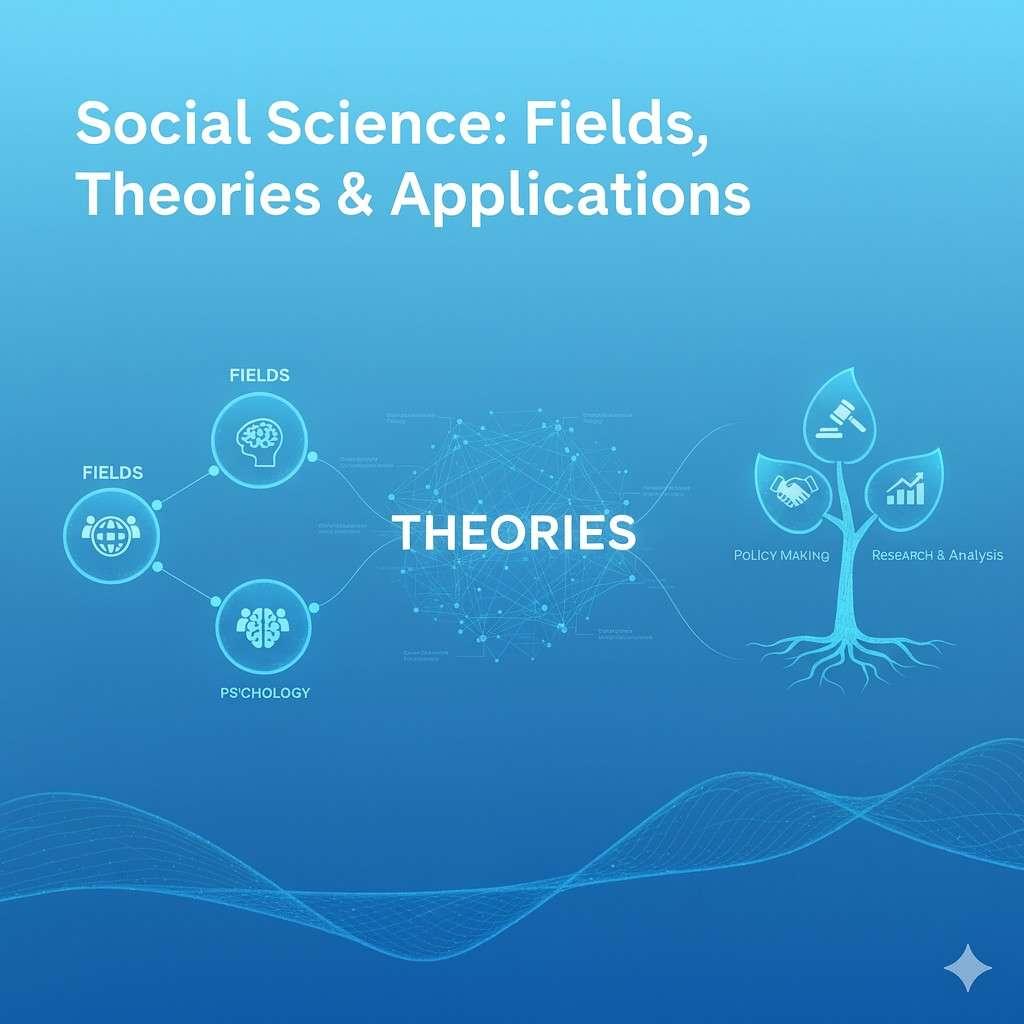
Social sciences refer to a category of academic fields of study that focus on a systematic examination of human behaviour, society, and social relations. They examine the interactions among individuals, groups, and institutions in terms of how they interact, organize and impact each other in different cultural, economic and political situations. The subject areas covered by the field include sociology, psychology, anthropology, political science, economics, geography, history and linguistics, and each of them deals with various aspects of human society.
Exploring the Field of Social Science
Social science is a broad and interdisciplinary field. It deals with the examination of social institutions such as family, government, and education, cultural norms, economic systems and political structures. Social scientists are interested in explaining small-scale processes, including individual behaviour and group dynamics, and large-scale processes, including societal change and global trends. Diversity and complexity of human societies can be seen in such specialized fields as demography, development studies, and linguistics.
Thinking Like a Social Scientist
Being a social scientist is critical, systematic and reflexive way of understanding the social world. Social scientists are questioning, analyzing and in search of evidence based explanation to social phenomena. They think about their personal views and social values, relate personal experience to the general social organisation, and compare the examination of personal agency to the impact of the social organisation. The importance of the context, including cultural, historical, and situational, is emphasized in interpreting the behaviour and social patterns.
Branches and Disciplines of Social Science
Major Disciplines
The core disciplines of social include:
- Sociology: The study of social structures, social groups and institutions and the subject of social order, social change and inequality. With the help of the surveys, interviews, and statistical studies, sociologists grasp the trends in common life.
- Psychology: The science that investigates behaviour, thinking and mentality at both individual and group levels. Psychologists apply experimentation, observation and surveys to examine the way people think, feel and behave.
- Anthropology: The study of human diversity, culture and evolution, usually through the use of ethnography and comparative approaches. Fieldwork and comparative analysis are performed by anthropologists to get an idea of how people live and come into existence.
- Political Science: The study of government, politics, policy and power relations. Case studies, surveys and modeling are methods employed by political scientists in analyzing systems of governance and political behaviour.
- Economics: The study of production, Allocation, and consumption of resources, the study of economic systems and the motivation. Economists study resource allocation by means of modeling, statistics, and experiments.
- Geography: The interactions of humans and the environment and the patterns of space (both physical and social sciences). Mapping, GIS and fieldwork help geographers to comprehend spatial relationships.
- History: Reconstructs and interprets the past societies and events often between social sciences and humanities. Archival research and analysis helps historians to comprehend change and continuity through time.
- Linguistics: The study of the structure of language, its use, and evolution is one of the essential studies of human communication. Descriptive, comparative, and analytical studies of language are done by linguists.
Social Science and Humanities
Although both social sciences and humanities are concerned with human experience, social concentrate on empirical investigations, and sometimes quantitative studies of social patterns, whereas humanities concentrate on interpretive and qualitative studies of culture and meaning. The borders are not distinct, and such disciplines as history, anthropology, and linguistics tend to be in the middle range of both worlds.
History and Theories in Social Science
History
Social can be dated to ancient philosophical debates by philosophers such as Plato and Aristotle. The discipline started forming itself as a separate academic field in the Enlightenment and became entrenched in the 19th century when sociology, economics, and anthropology as separate fields of study emerged. Other important individuals are Auguste Comte, who originated sociology and spread positivism, Karl Marx who formulated historical materialism, and Emile Durkheim who institutionalized sociology as a scientific field. Max Weber also developed interpretive methods, emphasizing on subjective meaning and social action.
Theories, Methods, and Values
The differences in theoretical frameworks in social science include:
- Structural Functionalism: Perceives the society as a structure of interconnected components which keep the society stable.
- Conflict Theory: Concentrates on power, inequality and social transformation.
- Symbolic Interactionism: Studies the ways that people create meaning by interacting.
Social sciences are methodologically based on both quantitative (surveys, experiments, statistical analysis) and qualitative (interviews, ethnography, case studies) methods. Mixed methods are becoming more popular and complete insights can be obtained. The social values are ethical research approaches, reflexivity, and a desire to comprehend the society and make it better.
Interdisciplinary Social Science
Interdisciplinary approaches are those approaches that combine theories and methods of various disciplines to offer solutions to a complex issue in the form of public health, environmental sustainability, and social justice. Such cooperation promotes critical thinking and the skills to effectively address complex problems in society.
Applications and Importance of Social Science
Importance of Social Science in Today’s World
Social plays a vital role in comprehending and responding to the modern issues such as inequality, health inequity, political polarization, and ecological disasters. It educates the political discourse, influences policy and facilitates social justice.
Applications of Social Science in Society
Evidence based health, education, welfare and criminal justice reforms are supported by social research. It guides market research, community development, and public policy making an intervention relevant and effective.
Understanding and Addressing Social Problems
Social science offers the means to understand how to analyze and solve social issues of poverty, discrimination, crime and inequity in health. Participatory and community-based research will make sure that solutions will be based on the lived experiences of the affected groups.
Role of Social Science in Society
Social creates the knowledge of the society, enlightens people in decision-making, and assists in formulating equitable and successful policies. It has an effect in government, business, education and non-profit sectors.
Social Science in Different Contexts
Social Institutions and Structures
Social looks at roles and functions of institutions such as family, education, religion and government and looks at how these institutions shape the behaviour and the outcomes of attitudes in the society.
Social Science and Culture
The science-based cultural studies examine the processes of the construction and transformation of beliefs, practices, and identities to pinpoint the dynamic character of culture and its influences on social cohesion and conflict.
Social Science in Education
In social science, education policy, curriculum, and practice have been informed by social science and it has tackled issues of equity, inclusion, and the purpose of education in social mobility.
Environment, Health, and Development
The social science research focuses on the human aspects of environmental change, health differences, and development, and highlights the significance of behavioural change, policy creation, and the community involvement in ensuring sustainability and well being.
Work and Social Science Perspectives
The study of the dynamics at the workplace examines power, organisational structures, and well-being, which guides human resources, workplace designs and interventions to enhance equity and mental health.
Careers and Opportunities in Social Science
Social Science Education: From Schools to Universities
The teaching of social starts at the elementary level and continues until higher education where the higher degrees provide an opportunity to pursue the specialized and leadership positions in teaching, research, and policy.
Careers in Social Science
Graduates of social sciences find their job in the academic field, government, business, non-profits, health care, education, and international organizations. These are policy analyst, researcher, market analyst, social worker, urban planner among others.
Career Paths With a Social Science Degree
The degree of social science exposes the graduates to various careers such as data analysis, market research, economic research, government service, education, and law. Critical and analytical skills in thinking are highly appreciated.
Future of Social Science
The future of the social is characterized by the increased need in the specialist knowledge of data analysis, policy assessment, and interdisciplinary research. Social scientists will remain an important factor in dealing with the global issues and creating a more fair and sustainable world.
Conclusion:
An effective social scientist is inquisitive, critical, moral, and devoted towards the understanding and making the society a better place. They consider different point of views, challenge assumptions, and implement strict approaches to the real-life issues. The most important qualities are reflexivity, humility, and the dedication to ethical research. Social is essential to construct knowledgeable, fair, and strong communities. Its wisdom informs policy, drives innovation and gives individuals and communities the capacity to cope with the change and uncertainty. The study of social science provides one with a valuable career and a chance to contribute to society positively. Cultures of socials , professional association, research and practice can be studied and contribute to a better future on all.
 Italiano
 English
 Arabic
 French
 Spanish
 Portuguese
 Deutsch
 Turkish
 Dutch
Dutch
 Russian
 Romaian
 Portuguese (Brazil)
 Greek
Greek