


Seabed Crawler Market to Surpass USD 1.9 billion by 2035
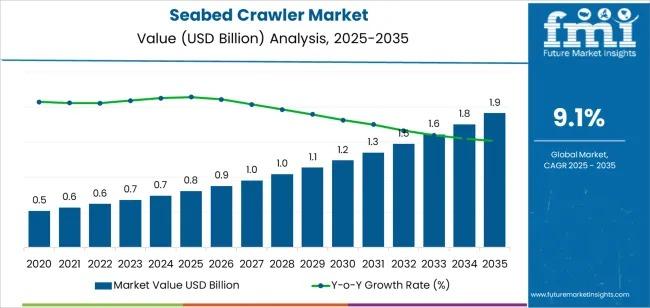
The Seabed Crawler Market is set to expand from USD 0.8 billion in 2025 to USD 1.9 billion by 2035, at a CAGR of 9.1%. Growth is fueled by rising demand in offshore oil and gas, renewable energy projects, deep-sea mineral exploration, and marine research missions. Tracked crawlers dominate with a 63% market share due to superior traction, stability, and load-handling capabilities across uneven seabeds and soft sediments. Multi-legged walking crawlers, representing 27%, serve specialized research missions requiring precision navigation in fragile or rocky environments.
Subscribe for Year-Round Insights → Stay ahead with quarterly and annual data updates: https://www.futuremarketinsights.com/reports/sample/rep-gb-28581
Key Product Types and Market Segments
Tracked Crawlers: Representing 63% of the market, tracked crawlers are widely used for trenching, cable burial, pipeline inspection, and deepwater geotechnical tasks. Their modular compatibility with cutters, survey sleds, and intervention skids enhances operational efficiency.
Multi-Legged Walking Crawlers: At 27%, this segment caters to precise environmental monitoring, ecological surveys, and fragile substrate inspections. Their mobility allows navigation in uneven and sensitive seabed areas without disturbing the ecosystem.
Applications:
- Offshore Oil & Gas (48%) – Pipeline inspection, seabed preparation, umbilical placement, and structural monitoring.
- Ocean Science & Research (28%) – Sediment sampling, benthic-habitat mapping, and environmental monitoring.
- Submarine Communications & Power (17%) – Cable laying, inspection, and burial across long marine routes.
Regional Insights
Asia Pacific: Leading the market with strong offshore energy investments in China, Japan, and Australia. China is projected to grow at 12.3% CAGR, driven by offshore wind, oilfield expansion, and marine research programs. India grows at 11.4% CAGR, leveraging port surveys, sediment analysis, and coastal-engineering applications.
Europe: Germany’s market grows at 10.5% CAGR, supported by offshore wind and regulated marine engineering. The UK expands at 7.7% CAGR, driven by turbine inspection, underwater cable monitoring, and ecological studies.
North America: The US grows at 8.6% CAGR, with demand from offshore energy, coastal-resilience projects, and marine research programs. Brazil’s market expands at 9.6% CAGR due to deepwater oil and gas operations and sediment analysis programs.
Japan: A stable 6.8% CAGR, supported by seismic-risk assessments, coastal engineering, and marine research initiatives.
Market Drivers
- Offshore Infrastructure Expansion: Growing oil & gas, offshore wind, and subsea projects increase the need for crawler-based inspection and intervention systems.
- Technological Advancements: Autonomous navigation, real-time sensor payloads, and hybrid ROV-crawler platforms enhance operational efficiency.
- Research & Exploration: Deep-sea mineral exploration, oceanographic surveys, and environmental monitoring require reliable and precise crawler operations.
Market Restraints
- High capital costs for manufacturing and deployment.
- Regulatory complexity related to environmental protection and sediment disturbance.
- Technical challenges including deep-sea pressure, remote communication, and maintenance requirements.
- Limited accessibility for small enterprises or academic institutions.
Competitive Landscape
The market is moderately consolidated with key players including:
- Royal IHC (20% global share) – Leading in robust tracked designs and dredging/trenching integration.
- Saab Seaeye, Oceaneering International, ECA Group – Hybrid and electric-powered crawlers for inspection and light construction.
- Fugro, Soil Machine Dynamics – Geotechnical and trenching-focused platforms.
- TechnipFMC, Forum Energy Technologies, Kawasaki Heavy Industries, Hyundai Heavy Industries – Heavy-duty crawler solutions for subsea construction.
Key competitive factors: Traction stability, payload capacity, sensor integration, endurance under deepwater pressure, and operational reliability.
Future Outlook
The seabed crawler market will experience two major transition phases:
- 2026–2029: Widespread adoption for oilfield inspection, pipeline monitoring, and mineral exploration.
- 2031–2033: Focus on high-endurance crawlers with advanced sensing, navigation stability, and low-impact sediment interaction.
The market is expected to stabilize as operators standardize crawler use in maintenance, inspection, and exploration operations.
 Dutch
Dutch
 English
 Arabic
 French
 Spanish
 Portuguese
 Deutsch
 Turkish
 Italiano
 Russian
 Romaian
 Portuguese (Brazil)
 Greek
Greek