


Fuel Injection Advantages in Modern Scooter Engines
Introduction to System Differences
When discussing the evolution of small-displacement powertrains, manufacturers such as those within a typical Scooter Engine Factory often highlight the transition from carburetor systems to fuel injection technology. The shift is driven by increasingly strict emission regulations, higher customer expectations for stability, and the need for improved adaptability across diverse operating conditions. Although carburetors have been used for decades due to their simplicity and low cost, fuel injection systems introduce new layers of precision and efficiency that significantly influence how scooters perform in daily transportation scenarios. Understanding the core differences clarifies why the industry continues to move toward more electronically controlled fuel delivery methods.
Precision of Fuel Metering
A key advantage of fuel injection systems lies in their ability to deliver fuel with exceptional precision. Unlike carburetors, which rely on pressure differentials and mechanical components to draw fuel into the airflow, fuel injection systems use electronic control units to regulate both the timing and quantity of fuel introduced into the combustion chamber. This precision ensures that the air-fuel mixture remains consistent regardless of altitude, temperature, or the rider’s throttle behavior. The result is more complete combustion, smoother power delivery, and fewer fluctuations under demanding conditions. Factories focused on engine innovation have found that this predictable metering reduces the likelihood of mixture imbalance and contributes to a more stable engine character.
Improved Fuel Efficiency and Emission Control
Fuel injection systems provide a significant boost in fuel efficiency because they avoid the inherent wastage found in carburetor designs. By matching the fuel supply directly to engine demands, the system reduces unnecessary richness and minimizes unburned hydrocarbons in the exhaust. This leads to lower overall fuel consumption across urban stop-and-go traffic as well as steady highway cruising. Additionally, many regulatory bodies require drastic reductions in emissions, and manufacturers must respond accordingly. Electronic fuel injection integrates seamlessly with catalytic converters, oxygen sensors, and exhaust monitoring equipment, enabling precise adjustment to maintain compliance with evolving standards. These capabilities make fuel injection particularly attractive to any Scooter Engine Factory seeking long-term competitiveness and environmental responsibility.
Enhanced Starting Performance and Cold-Weather Reliability
Carbureted systems often struggle during cold starts because the fuel may not vaporize efficiently at lower temperatures, requiring choke adjustments or repeated attempts. Fuel injection systems eliminate this issue by automatically adjusting the mixture to compensate for temperature variations. Sensors detect ambient conditions and guide the control unit to enrich the mixture only as needed, providing quick, reliable starts even in harsh climates. Riders benefit from smoother initial acceleration, reduced warm-up times, and less mechanical wear on engine components. The consistency of starting behavior is important for daily commuters and delivery riders who depend on reliable engine response throughout the year.
Reduced Maintenance and Longer Component Life
Fuel injection systems generally require less frequent maintenance compared with carburetors, which are more prone to clogging, residue buildup, and mechanical wear. Carburetors often need periodic cleaning and manual adjustments to maintain proper performance. By contrast, fuel injectors operate under closed-loop control and experience fewer issues related to fuel impurities or atmospheric changes. Although injectors can become dirty over long periods, the need for maintenance is substantially reduced, and the interval between servicing is typically much longer. This not only lowers lifetime operating costs but also enhances overall reliability. For a Scooter Engine Factory, emphasizing reduced maintenance can be a strong selling point in markets where convenience and durability are key customer priorities.
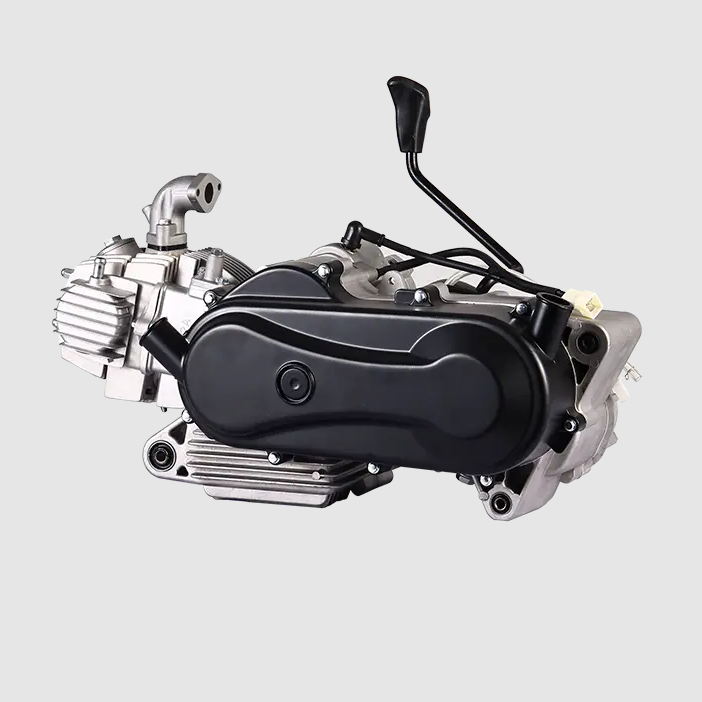
Nominal displacement:50ml
Displacement:49.4ml
Bore:39mm
Stroke:41.4mm
Compression ratio:10.5:1
Maximum power:2.7kw/7000r/min
Maximum torque:3.2N·m/5500r/min
Maximin fuel comsumption:≤367g/kW·h
Minimum stable idle speed:1700±100r/min
 Portuguese
 English
 Arabic
 French
 Spanish
 Deutsch
 Turkish
 Dutch
Dutch
 Italiano
 Russian
 Romaian
 Portuguese (Brazil)
 Greek
Greek