


Spring Starter vs Hydraulic Motor
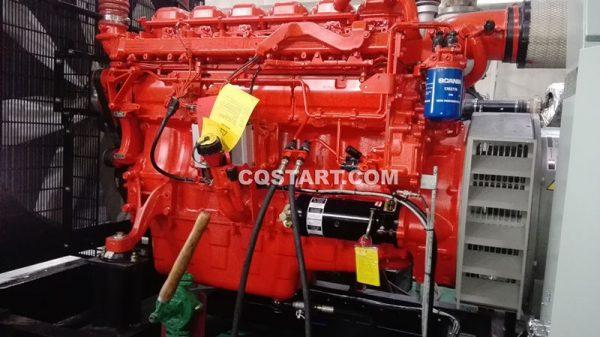
Spring starters and hydraulic motors are both mechanical power devices, but they differ drastically in energy storage, working mechanisms, and application scenarios. Understanding their core distinctions is critical for selecting the right equipment in industrial, automotive, or marine fields. Below is a detailed comparison from four core dimensions.
1. Core Definition & Working Principle: Fundamental Differences in Energy Conversion
The essence of their divergence lies in how they store and release energy—this directly determines their functional positioning.
1.1 Spring Starter: Mechanical Energy Storage for "Instant Startup"
A spring starter relies on mechanical spring compression to store energy. Its core component is a high-strength coil spring: when activated (usually by manual handle rotation or small auxiliary force), the spring is compressed to accumulate potential energy. When triggered, the spring rapidly expands, driving gears or clutches to transmit torque to the target device (e.g., engine crankshaft), achieving instant startup.
It operates independently of external energy sources (no electricity, hydraulic oil) and converts human power or low-power input into high-torque output in a short time.
1.2 Hydraulic Motor: Fluid Pressure for "Continuous Power Output"
A hydraulic motor is a component in hydraulic systems that converts hydraulic energy (pressurized fluid) into mechanical energy. It relies on an external hydraulic pump to pressurize oil; the high-pressure oil flows into the motor’s internal cavity, pushing rotors (gear, vane, or piston types) to rotate, and then outputs continuous torque and speed to drive machinery.
Its operation depends entirely on a matched hydraulic system (pump, oil tank, pipelines) and cannot work independently—unlike the self-contained spring starter.
2. Application Scenarios: Targeting Different Functional Needs
Their principle differences lead to distinct application focuses: one for "startup assistance" and the other for "sustained drive."
2.1 Spring Starter: Emergency & Independent Startup Scenarios
Due to its independent energy storage and instant torque output, it is mainly used for starting engines/machinery in scenarios lacking external energy:
- Emergency backup: Diesel generators in hospitals, data centers (as a backup for failed electric starters).
- Remote areas: Agricultural machinery (small tractors) or construction equipment (portable compressors) without power grids.
- Harsh environments: Marine lifeboats (resisting salt spray corrosion) or coal mine equipment (no spark risk).
Its core role is "assistive startup," not long-term power supply.
2.2 Hydraulic Motor: Continuous & High-Load Drive Scenarios
With continuous torque output and adjustable speed, it is designed for long-term operation of heavy machinery:
- Construction: Excavator arms, crane rotations (needing stable torque for lifting heavy loads).
- Manufacturing: Conveyor belts in factories, injection molding machine actuators (requiring adjustable speed).
- Marine: Ship propellers (adapting to variable water resistance with flexible speed control).
Its core role is "sustained power drive," supporting the main operation of equipment.
3. Performance & Maintenance: Contrasting Reliability and Cost
Performance indicators like torque, speed, and maintenance difficulty further distinguish the two.
3.1 Torque & Speed: "Instant Burst" vs "Continuous Stability"
- Spring Starter: Outputs high instant torque (to overcome engine startup resistance) but has a short duration (only a few seconds) and fixed speed (determined by spring expansion rate, non-adjustable).
- Hydraulic Motor: Provides stable continuous torque (adjustable via hydraulic oil pressure) and flexible speed (controllable by oil flow), suitable for long-term variable-load work.
3.2 Maintenance & Durability: "Simple Low-Cost" vs "System-Dependent"
- Spring Starter: Few components (spring, gears) with no electrical/hydraulic parts. Maintenance only requires occasional lubrication; service life can exceed 10,000 startup cycles.
- Hydraulic Motor: Relies on hydraulic system maintenance—oil replacement, pipeline leak checks, and filter cleaning are necessary. Failure of any system part (e.g., pump) affects the motor, leading to higher overall maintenance costs.
4. Conclusion: How to Choose? Match Scenarios to Core Needs
The two devices are not competitive but complementary, selected based on "functional goal":
- Choose a spring starter if you need: Independent emergency startup, no external energy, low maintenance, and short-term torque output.
- Choose a hydraulic motor if you need: Continuous power drive, adjustable speed/torque, and support for heavy-load long-term operation (with a matched hydraulic system).
In summary, spring starters solve "how to start machinery without power," while hydraulic motors solve "how to drive machinery stably for a long time"—each playing an irreplaceable role in their respective fields.
© 2026 Scenario.press - libera espressione
 Romaian
Romaian
 English
 Arabic
 French
 Spanish
 Portuguese
 Deutsch
 Turkish
 Dutch
Dutch
 Italiano
 Russian
 Portuguese (Brazil)
 Greek
Greek