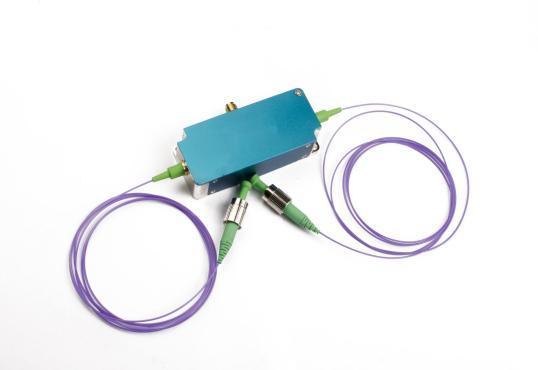
If you’re looking for a device that precisely adjusts laser intensity and shifts its frequency, the 780nm Fiber AOM Series is built to meet these needs. It works based on the acousto-optic interaction principle, compatible with light from visible to infrared wavelengths—making it flexible for various optical setups, from lab experiments to industrial applications. To ensure long-term use, it features an all-metal structure, compact sealed packaging, and advanced packaging technology, which keep it stable even when the temperature changes.
This series stands out for practical features that make it easy to integrate and use:
- Fast response time: It adjusts laser signals quickly, which is crucial for tasks that require real-time laser control, like high-speed testing or precision processing.
- Low insertion loss: It minimizes the loss of laser signal strength, so more of the original laser power reaches your target, keeping your system efficient.
- High extinction ratio: It provides clear “on-off” control of the laser beam, reducing unwanted interference and ensuring sharp, reliable signals.
- Compact size: It takes up little space in your optical system, making it simple to fit alongside other components without crowding.
- Strong temperature stability: It maintains consistent performance even if the environment’s temperature fluctuates—ideal for both lab and factory settings.
This product is designed to solve real-world challenges in scenarios that need precise laser control:
- Q-switched fiber lasers: It helps regulate the laser’s pulse output, which is essential for tasks like laser cutting, engraving, or scientific research that demand controlled laser pulses.
- Laser Doppler coherent systems: It supports accurate measurements of velocity or vibration, often used in engineering tests (e.g., checking machine vibration) or physics experiments.
- Ultra-fast laser frequency reduction: It lowers the frequency of high-speed lasers to match the requirements of your system, ensuring compatibility with other components.
- Linear frequency modulation: It enables smooth, steady adjustments to the laser’s frequency, useful for optical communication projects or sensing applications (e.g., environmental monitoring).
The 780nm Fiber AOM Series offers four main models—SGTF80-780-1P, SGTF150-780-1P, SGTF200-780-1P, and SGTF400-780-1P—each tailored to different speed and performance needs. Here are the key details to help you choose:
- Insertion loss: Ranges from <3 dB (for SGTF80-780-1P) to <4 dB (for SGTF400-780-1P), keeping signal loss to a minimum.
- Rise time: As fast as <8 ns (for SGTF400-780-1P), perfect for high-speed operations that need quick signal changes.
- On-off extinction ratio: ≥50 dB for all models, ensuring strong control over the laser’s on/off state.
- Wavelength: 780 nm (typical), but custom wavelengths are available if your project requires them.
- Optical power: Handles up to 0.5 W, ensuring safe and stable operation.
- Packaging: Choose between FA or FH options to fit your installation space.
To get the best performance from your 780nm Fiber AOM, we recommend pairing it with the dedicated Low-Power N-type Acousto Optic Driver. This RF (radio frequency) device (with output power <3W) generates signals that create ultrasonic waves in the AOM’s crystal—these waves are what let the AOM modulate, deflect, or tune the laser beam.
- Efficient heat dissipation: Its all-metal housing keeps it cool, preventing overheating and maintaining consistent performance.
- Compact design: It fits easily with the AOM, saving space in your overall system.
- Low power use: It consumes less energy while still delivering reliable results, helping reduce operating costs.
Popular driver models include SGT80-33-N-1D, SGT150-33-N2-1A1, SGT200-33-N-1A5, and SGT400-33-N2-1D. Key specs include:
- Modulation input: Supports both digital (3.3–5V high level) and analog (0–1V or 0–5V) signals, fitting different control setups.
- RF output frequency: Matches the AOM models (80 MHz, 150 MHz, 200 MHz, or 400 MHz) for seamless compatibility.
- Working voltage: 24V DC (standard) or 12V DC (optional), to fit your power supply.
For more details—including product images, custom quotation requests, or full technical drawings of the 780nm Fiber AOM Series and its matching driver—visit our official page:
780nm Fiber AOM Series



 Greek
Greek
 English
 Arabic
 French
 Spanish
 Portuguese
 Deutsch
 Turkish
 Dutch
Dutch
 Italiano
 Russian
 Romaian
 Portuguese (Brazil)