


RFID vs Barcode: What’s Best for Asset Tracking Software? - Maco Infotech
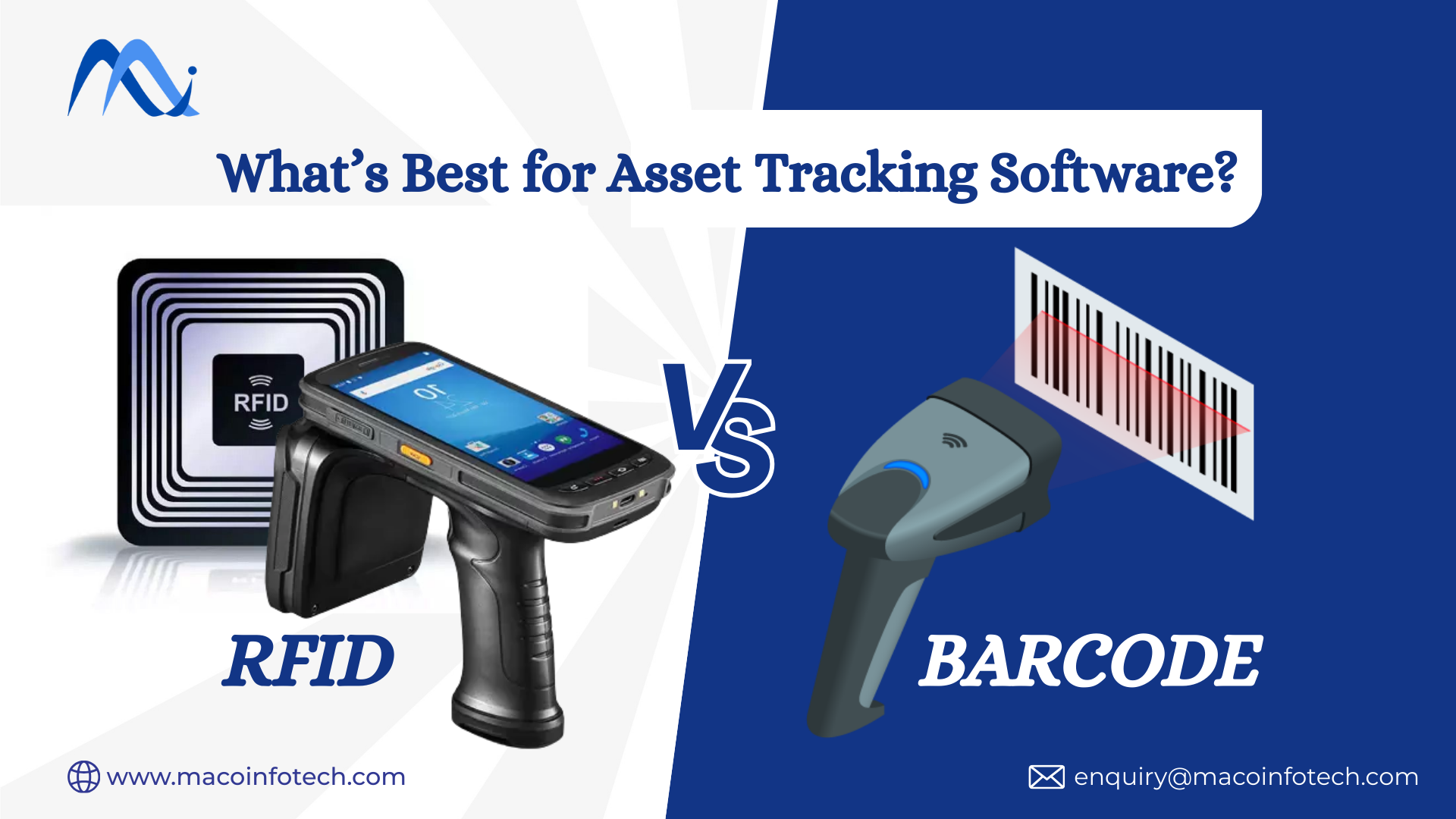
When it comes to asset tracking, most people are familiar with the barcode system, where the QR code is now taking the lead; however, both work in the same manner. RFID technology, which is more advanced and highly automated, is growing fast and replacing barcode technology in organizations that can afford the cost and require fast, accurate results. Both systems have their strengths and limitations, and the choice between them largely depends on your organization’s size, budget, and tracking requirements. Here’s a detailed comparison of RFID vs. Barcode to help you decide what’s best for your asset tracking software:
1. Technology and Functionality
Barcode: Barcodes are labels created using systematic information or generated with unique numbers and affixed to assets according to the requirements of the software or the user’s asset management plan. The relevant mobile apps are installed on barcode readers, which are connected to the software to perform a physical asset audit. The person performing the audit needs to scan each barcode tag to complete the task. Barcode scanning requires utmost care to ensure accuracy and a meaningful audit.
RFID: RFID tags are chip-based and attached to assets according to the software setup. The appropriate mobile app is installed on the handheld RFID reader, which is linked to the software for conducting the physical asset audit. The person performing the audit moves with the handheld device to cover all locations where tagged assets are placed. Scanning RFID tags is much easier, as the reader detects radio waves and updates the data, even scanning multiple tags simultaneously. RFID readers can even scan items inside sealed boxes, provided the tags and readers are of good quality and the software supports the function.
2. Comparison in Technology
Barcode: Scanning each barcode must be done manually; therefore, it is slow, time-consuming, labor-intensive, and prone to mistakes when asset data is large in volume.
RFID:RFID readers can scan multiple assets simultaneously from a distance and even through boxes, completing physical asset audits smoothly, easily, error-free, and efficiently.Maco AMS offers both technologies in a single software solution, allowing you to choose tags that suit a particular asset while keeping cost in mind.
3. Cost
Barcode:Barcodes are initially less expensive and do not require pricey readers or antennae. They require more work and are slower, though. For medium-sized and small businesses, particularly those just starting, they continue to be a tried-and-true solution.
RFID:The initial cost of RFID systems is higher. Compared to barcodes, tags, readers, and software integration are more costly. For large-scale businesses, however, the ROI over time can make the expenditure worthwhile.
4. Sturdiness and Readability
Barcode:Over time, barcodes may deteriorate, particularly in challenging conditions. They may become unreadable due to fading, dirt, or scratches.
RFID:RFID tags can be installed inside or on unseen components of an object and are more resilient. They are perfect for harsh environments like manufacturing facilities or outdoor applications.
5. Security and Data Storage
Barcode:A barcode stores only a limited amount of data, usually a serial number, and must be linked to a database to access more information.
RFID:RFID is more secure for tracking valuable or sensitive assets since it can store more data directly on the tag and can include authentication and encryption functions.
Conclusion
Barcode technology is a great choice for companies with low tracking needs and a limited budget. It is affordable and easy to use, especially in environments with low inventories or when manual scanning is practical.
But RFID offers unparalleled speed, automation, and scalability. Businesses with challenging environments, intricate processes, or huge asset numbers will find it suitable.
The ideal solution ultimately depends on your unique business requirements. To stay ahead of the competition, many modern firms are opting for Maco AMS, which offers RFID, barcode, and QR code-based asset tracking in one platform for long-term efficiency and growth.
Despite the potential higher upfront costs, RFID technology offers long-term cost savings, improved control, and a significant increase in operational efficiency.
 Deutsch
 English
 Arabic
 French
 Spanish
 Portuguese
 Turkish
 Dutch
Dutch
 Italiano
 Russian
 Romaian
 Portuguese (Brazil)
 Greek
Greek