


Understanding the Operational Principles of Density Meters
Density, a fundamental physical property, holds significant importance across various industries and scientific domains. Density meters, specialized instruments designed to measure the density of liquids and solids, employ diverse measurement techniques grounded in established scientific principles. This article provides insights into the operational principles of density meters, elucidating how they facilitate precise density measurements.
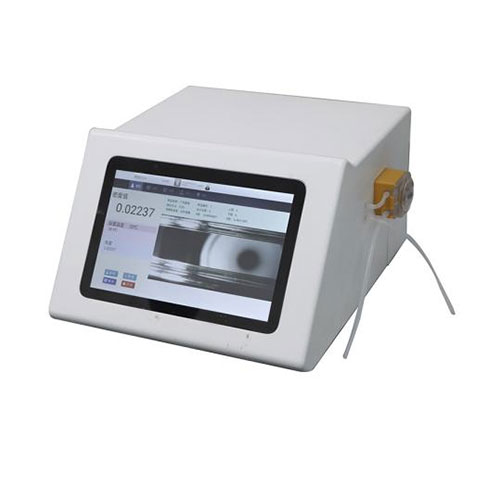
Working Principle of a Density Meter:
The operating principle of a density meter hinges on Archimedes' principle of buoyancy. Here's a stepwise breakdown of how density meters operate:
Buoyancy Measurement:
The sample under examination is placed within a measurement chamber equipped with a transducer or sensor to gauge the buoyant force exerted on the object.
Reference Measurement:
Prior to analyzing the sample, the density meter undergoes calibration using a known density reference material to ensure measurement accuracy.
Sample Introduction:
The sample is introduced into the measurement chamber, which may accommodate either liquid or solid samples, often with provisions for temperature regulation to ensure consistent readings.
Buoyant Force Measurement:
Upon immersion in a fluid, the sample experiences an upward force termed buoyant force, arising from its displacement of the fluid.
Sensor Detection:
The density meter's transducer or sensor detects the buoyant force exerted on the sample, typically converting this measurement into an electrical signal for processing.
Density Calculation:
Leveraging calibration data derived from the reference material, the density meter computes the sample's density based on the measured buoyant force.
Display and Output:
The estimated density value is displayed on the density meter's screen or transmitted to an external device for further analysis. Some density meters offer additional features like temperature compensation or specific gravity calculation.
It's important to note that different types of density meters may employ varying operating principles and measurement procedures. Nonetheless, the underlying principle of measuring buoyant force remains consistent across these instruments.
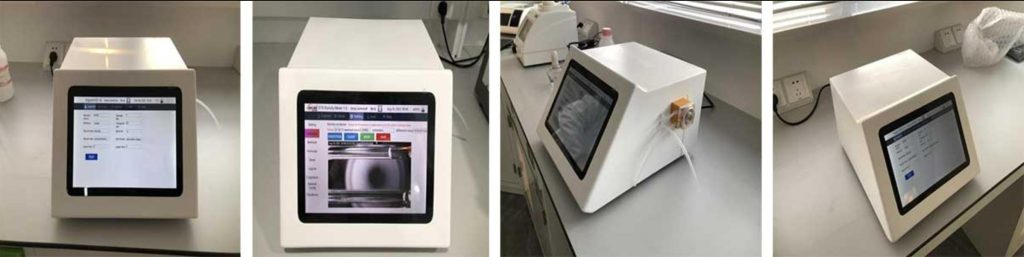
Working Mechanism of Density Meters:
Oscillation-Based Density Meters:
Oscillation-based density meters, including oscillating U-tube and vibrating tube density meters, utilize oscillation frequency to determine density.
Oscillation Initiation: The density meter initiates oscillation or vibration within a chamber or tube, often facilitated by a piezoelectric or vibrating device.
Frequency Measurement: Sensors or transducers in the density meter measure the resonant frequency of the oscillation, which is influenced by the sample's bulk and density.
Comparison with Reference: The measured resonant frequency is compared to a known reference frequency associated with a predetermined density value.
Density Calculation: Based on the frequency difference between the measured and reference frequencies, the density meter calculates the sample's density using calibration data.
Vibrating Element-Based Density Meters:
Vibrating element-based density meters, such as tuning fork density meters, exploit the damping effect on a vibrating element immersed in a fluid to ascertain density.
Vibrating Element: The density meter sets a vibrating element, such as a quartz crystal or tuning fork, into motion at a specific frequency.
Damping Effect: Immersion of the vibrating element in the sample fluid induces a damping effect influenced by the fluid's density.
Frequency Shift Measurement: Sensors or transducers detect the frequency shift in the vibrating element induced by the damping effect.
Calibration and Conversion: The density meter is calibrated using known density reference standards to establish a correlation between frequency shift and density, enabling conversion of the former into a corresponding density value.
Summary:
Density meters serve as invaluable tools for estimating the density of liquids and solids, contributing to quality control, process optimization, and research endeavors. By leveraging established principles like Archimedes' law and innovative measurement techniques, density meters offer accurate and reliable density readings, facilitating breakthroughs across various domains.
 Spanish
 English
 Arabic
 French
 Portuguese
 Deutsch
 Turkish
 Dutch
Dutch
 Italiano
 Russian
 Romaian
 Portuguese (Brazil)
 Greek
Greek