


Generative AI In Pharmaceutical Market Advances With Deep Learning and Predictive Models
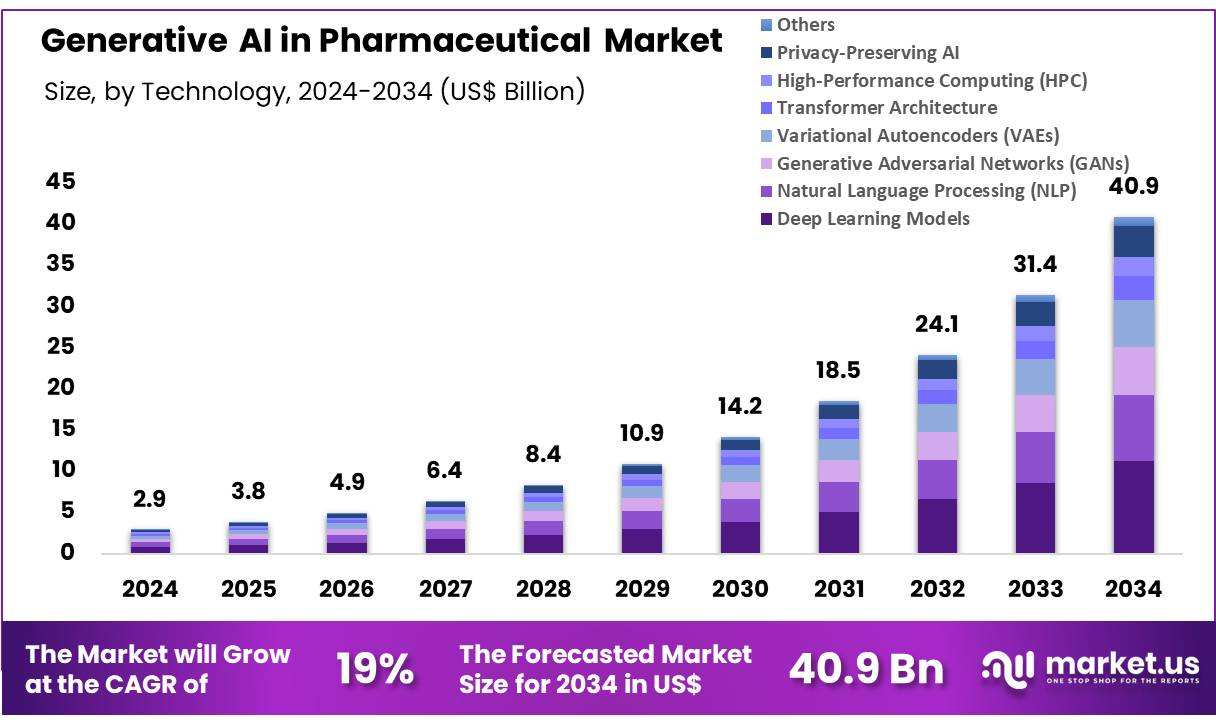
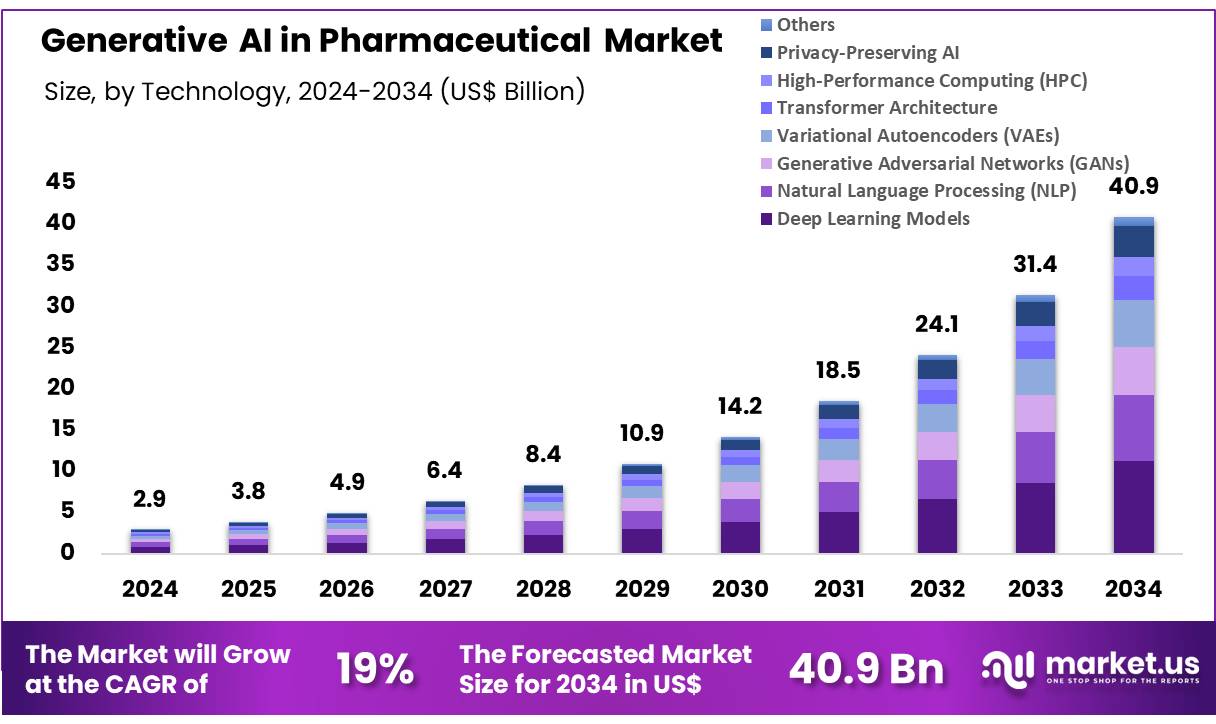
The global Generative AI in Pharmaceutical Market is expected to reach approximately USD 40.88 billion by 2034, rising from USD 2.92 billion in 2024. This reflects an impressive compound annual growth rate (CAGR) of 30.2% between 2025 and 2034. Generative AI is becoming a powerful tool in pharmaceutical research. It is speeding up the drug development process, optimizing clinical trials, and enabling more personalized medicine. By using AI models, researchers can simulate thousands of drug compounds and reduce time spent on early-stage trials.
One major growth driver is the urgent need to reduce drug discovery timelines. According to the U.S. Food and Drug Administration (FDA), it can take up to 10 years to launch a new drug. Generative AI helps shorten this period by predicting how different drug compounds may interact with the body. This speeds up research and allows companies to identify promising candidates earlier. The technology supports rapid compound screening and enhances drug design, saving both time and resources.
Governments and global health agencies are supporting this transformation. Organizations like the U.S. National Institutes of Health (NIH), European Medicines Agency (EMA), and the World Health Organization (WHO) are backing AI-based research. These institutions are funding projects that use AI to improve drug safety, refine clinical trial methods, and develop more accurate disease models. The U.S. Centers for Disease Control and Prevention (CDC) and WHO are also offering access to open health data, encouraging AI-driven analysis. Generative AI also benefits from the rise in real-world data usage. Electronic health records and public health databases are now widely used to train AI models. WHO encourages the use of such data to improve health outcomes. Generative AI tools analyze these vast data sets to reveal patterns and identify new treatment options. This approach helps in tackling complex diseases, including cancer, Alzheimer's, and rare disorders, more effectively.
Key Takeaways
- In 2024, the Generative AI in Pharmaceutical market generated US$ 2.92 billion in revenue, showing strong momentum in tech-driven healthcare innovation.
- The market is projected to surge at a CAGR of 30.2%, reaching approximately US$ 40.88 billion by the year 2034.
- Among the technology types, Deep Learning Models led the way in 2024, accounting for 27.4% of the total market share.
- Other popular technologies in this space include NLP, GANs, VAEs, Transformer Architecture, HPC, and Privacy-Preserving AI.
- By method, Text Generation dominated with a 39.7% market share, widely used in pharma documentation and clinical content generation.
- The application area with the largest share was Research and Development, contributing 22.4% to the total market revenue.
- Other key applications include Commercial uses, Drug Discovery, Clinical Development, and Operational enhancements in pharmaceutical workflows.
- North America held the lion’s share of the market in 2024, capturing 46.8% due to robust AI adoption and healthcare infrastructure.
GET SAMPLE REPORT : https://market.us/report/generative-ai-in-pharmaceutical-market/free-sample/
Regional Analysis
North America holds a dominant 46.8% market share in the generative AI in pharmaceutical market. This region is at the forefront of AI adoption and innovation in drug development. The U.S., in particular, is home to top pharmaceutical and biotech firms. It also hosts world-renowned AI research institutions. These elements create a thriving ecosystem for AI-driven drug discovery. Generative AI is widely used for drug design, clinical trials, and personalized medicine. This boosts efficiency and reduces time-to-market in drug development.
The pharmaceutical industry in North America benefits from strong support by major technology firms. Companies like Google, Microsoft, and IBM play a key role in providing AI infrastructure. Their platforms support data processing, modeling, and cloud-based tools tailored for healthcare. These resources make it easier for pharma companies to adopt and scale generative AI solutions. The U.S. also offers a growing network of startups and AI vendors. This ensures constant innovation and competition, which pushes the industry forward at a rapid pace.
The U.S. regulatory framework further strengthens North America’s leadership. Agencies like the FDA are actively evolving to accommodate AI-based tools. They are setting guidelines to ensure AI use is ethical, transparent, and effective in clinical settings. These steps help pharma companies feel more confident about integrating generative AI. The balance between innovation and regulation is key. It allows safe and quick adoption of new technologies. As a result, the region becomes more attractive to investors and global pharmaceutical firms.
In September 2024, Deloitte launched its AI Factory as a Service to support the GenAI market. This platform uses the NVIDIA AI ecosystem, including AI Enterprise software and NIM Agent Blueprints. It also incorporates Oracle’s enterprise AI technology. Deloitte combines AI tools with deep industry knowledge to deliver complete AI workflows. This move aims to help pharma firms streamline operations using GenAI. By uniting top tech with domain expertise, Deloitte sets a new standard in AI integration for healthcare and pharmaceuticals.
Conclusion
In conclusion, generative AI is bringing a major shift to the pharmaceutical industry. It is making drug discovery faster, clinical trials smarter, and treatments more personalized. By using real-world data and advanced AI models, companies can now develop safer and more effective medicines with less time and cost. Support from global health agencies and the use of open health data are also helping this technology grow. As more pharma companies adopt AI tools, the future of medicine looks more precise and patient-centered. Generative AI is not just a trend—it is becoming a key part of how modern healthcare evolves and delivers better outcomes worldwide.
 French
 English
 Arabic
 Spanish
 Portuguese
 Deutsch
 Turkish
 Dutch
Dutch
 Italiano
 Russian
 Romaian
 Portuguese (Brazil)
 Greek
Greek