


Aluminum and Stainless Steel Rivets: How to Choose the Right Rivets
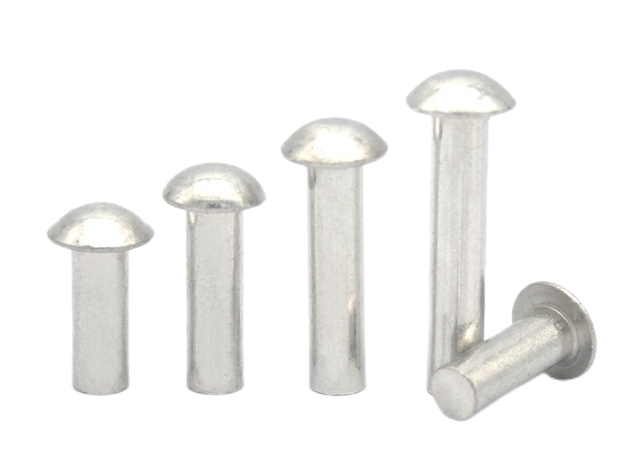
A rivet serves as a crucial fastening element, featuring a capped end for connecting various parts through deformation or interference. Diverse materials are employed in rivet manufacturing, with iron, aluminum, stainless steel, alloy, and nylon being common choices. Stainless steel and aluminum rivets, in particular, differ in material, performance, usage, and price.
Differences Between Stainless Steel and Aluminum Rivets:
Material:
Stainless steel rivets are crafted from stainless steel, while aluminum rivets are made of aluminum. Variations include all-aluminum, all-stainless steel, aluminum-steel, and aluminum-stainless steel rivets.
Performance:
aluminum rivets exhibit greater tensile and shear resistance compared to stainless steel rivets, thanks to the higher hardness of stainless steel.
Usage:
Stainless steel rivets are well-suited for applications requiring high fastening strength, whereas aluminum rivets are predominantly used for civilian workpieces.
Price:
Due to higher production costs, stainless steel rivets tend to be more expensive than aluminum rivets of similar specifications.
Choosing Between Aluminum and Stainless Steel Rivets:
Selecting Aluminum Rivets:
In aviation, aluminum rivets find widespread use due to their versatility.
Solid rivets made of aluminum or aluminum alloys are suitable for non-structural or lightly-loaded structural parts.
Blind rivets like aluminum 5050 and 5056 are common in daily applications, including structural and closed blind rivets for specific requirements.
Note: When riveting aluminum plates, it is crucial to avoid stainless steel rivets to prevent chemical reactions and corrosion; aluminum rivets are the appropriate choice.
Selecting Stainless Steel Rivets:
Stainless steel rivets are ideal for fastening high-strength workpieces.
Half-round head rivets handle lateral loads well.
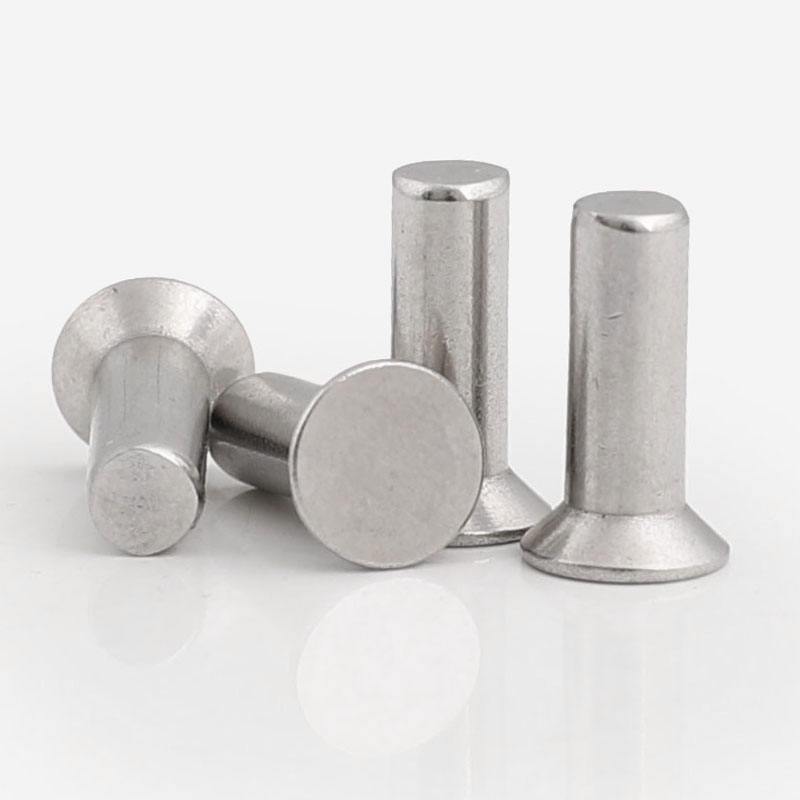
Flat cone head rivets, resistant to corrosion, are suitable for environments like ship hulls and boiler water tanks.
Flat-head rivets work well for ordinary loads.
Flat head and oblate head rivets are designed for metal sheets or non-metallic materials like leather, canvas, and wood.
Note: Semi-hollow stainless steel rivets, featuring a processed-sinking cylindrical part, are specifically used in riveting applications.
Conclusion:
When choosing between aluminum and stainless steel rivets, it is crucial to consider the specific requirements of the application. Each type of rivet has its advantages, making it essential to select the appropriate one based on factors such as material compatibility, strength requirements, and environmental conditions.
 Dutch
Dutch
 English
 Arabic
 French
 Spanish
 Portuguese
 Deutsch
 Turkish
 Italiano
 Russian
 Romaian
 Portuguese (Brazil)
 Greek
Greek