


How to Design Tension Spring
Tension springs serve as indispensable components in various mechanical systems, absorbing and storing energy to facilitate movement control. Achieving optimal and reliable performance hinges on meticulous tension spring design. This article delves into the critical factors, calculations, considerations, and testing procedures pivotal in crafting effective tension spring designs.
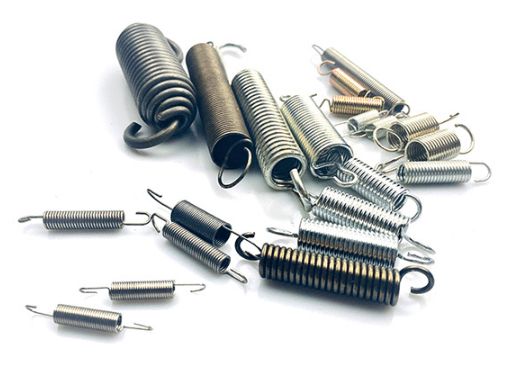
Key Factors in Tension Spring Design
Material Selection:
The chosen material must withstand anticipated loads, considering factors like temperature range, corrosion resistance, and fatigue life.
Wire Size:
Wire diameter determines spring force. Thicker wires yield stronger springs with higher spring rates.
Coil Diameter:
The outer diameter affects coil count necessary to achieve desired length and load.
Pitch:
Closer coils produce stronger springs with higher spring rates.
Number of Coils:
Depends on desired spring length and load, calculated using spring rate and deflection.
Initial Tension:
Force required for initial compression or extension, calculated using spring rate and coil count.
Calculations in Tension Spring Design
Spring Rate Calculation:
Determined by the formula: Spring Rate = (G x d^4) / (8 x D^3 x n)
Maximum Load Calculation:
Derived from: Maximum Load = (G x d^4 x L) / (8 x D^3 x n^3)
Maximum Deflection Calculation:
Computed by: Maximum Deflection = (8 x F x L^3) / (G x d^4 x π^3 x n^3)
Stress Calculation:
Expressed as: Stress = (F x D) / (8 x d^3 x n)
Additional Considerations in Tension Spring Design
End Type Selection:
Varies with application; options include closed ends, open ends, hooks, and tangs.
Bend Radii:
Must be adequate to prevent stress concentrations and premature failure.
Surface Finish:
Smooth finish reduces friction, enhancing spring longevity.
Shot Peening:
Improves fatigue life by inducing compressive stresses, mitigating damage from cyclic loading.
Stress Relief:
Heat treatment process reduces residual stresses, forestalling premature failure.

Prototyping and Testing in Tension Spring Design
Importance of Prototyping:
Critical for evaluating design and identifying unforeseen issues, aiding in the troubleshooting of tension spring manufacturing.
Testing Methods:
Include compression, tension, fatigue, and load deflection tests to assess real-world performance.
Evaluation of Results:
Testing outcomes scrutinized to ensure compliance with performance criteria, prompting design modifications as necessary.
Iterative Design Process:
Often entails multiple rounds of prototyping and testing to refine design and meet performance benchmarks.
Conclusion
Crafting tension spring designs demands meticulous attention to factors, calculations, considerations, and testing. By adhering to these guidelines, designers can ensure optimal, reliable performance, culminating in successful mechanical systems.
 Italiano
 English
 Arabic
 French
 Spanish
 Portuguese
 Deutsch
 Turkish
 Dutch
Dutch
 Russian
 Romaian
 Portuguese (Brazil)
 Greek
Greek