


Solving Mechanical Seal Bearing Failure in Industrial Pumps
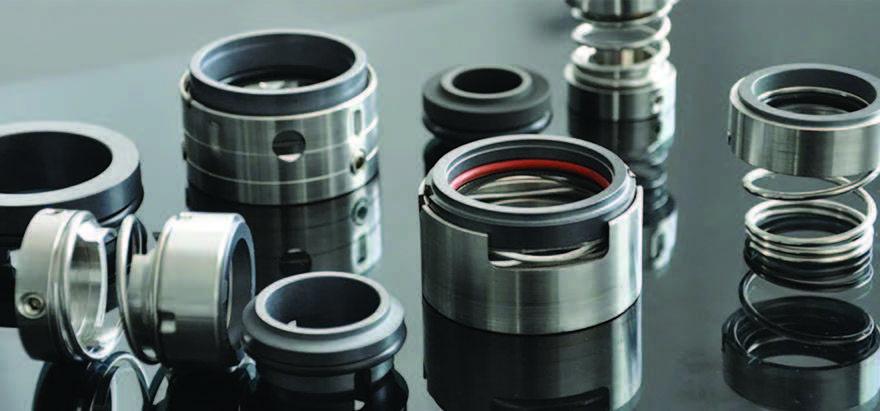
In the demanding world of B2B industrial maintenance and automotive fluid systems, few components are as interdependent as the mechanical seal bearing. While often discussed as separate entities, in high-performance centrifugal pumps and cooling systems, they operate as a unified assembly. When the bearing fails to provide rigid shaft support, the mechanical seal inevitably leaks; conversely, a weeping seal can quickly wash away bearing lubrication, leading to a catastrophic seizure.
For plant engineers and fleet maintenance managers, mastering this relationship is the key to extending MTBF (Mean Time Between Failure) and protecting the bottom line from the high costs of unscheduled downtime.
The Problem: The Destructive Cycle of Shaft Instability
The primary function of a bearing in a sealed system is to maintain "zero" shaft deflection. However, several systemic issues often disrupt this stability, leading to a rapid decline in equipment health.
1. Radial Play and Face Distortion
A mechanical seal relies on two microscopic, flat surfaces—one stationary and one rotating—sliding against each other. If the radial ball bearing or tapered roller bearing supporting the shaft develops excessive "play," the shaft will oscillate. This movement causes the seal faces to "open" momentarily, allowing pressurized fluid to bypass the primary seal.
2. Lubricant Contamination (The "Washout" Effect)
The most common cause of bearing failure in pump applications is fluid ingress. If the mechanical seal suffers a minor leak, the process fluid (often abrasive or corrosive) can travel down the shaft and penetrate the bearing housing. This "washes out" the specialized grease, replacing it with a substance that provides zero film strength. The result is rapid pitting and thermal expansion of the rolling elements.
3. Harmonic Vibration and Bearing Fatigue
In many B2B industrial settings, pumps are forced to operate away from their Best Efficiency Point (BEP). This creates hydraulic instability and cavitation, which translates into high-frequency vibration. These vibrations are absorbed directly by the bearing, leading to false brinelling—a condition where the rollers wear grooves into the raceway while the machine is stationary or under low load.
The Professional Solution: A Systemic Approach to Reliability
To solve the "mechanical seal bearing" dilemma, maintenance professionals must move beyond simply replacing parts. A strategic solution involves upgrading the hardware and the monitoring protocols.
Implementing "Dry-Running" Protection
Since heat is the enemy of both the seal and the bearing, utilizing silicon carbide or tungsten carbide seal faces can provide a higher margin of safety. These materials handle the friction of "dry-running" better than carbon-ceramic alternatives, preventing the heat transfer that often cooks the nearby bearing lubricant.
Precision Alignment and Balanced Assemblies
In the B2B sector, "close enough" is never enough for high-speed shafts. Utilizing laser alignment tools to ensure the motor and pump shafts are perfectly concentric is mandatory. Furthermore, ensuring that the impeller is dynamically balanced reduces the centrifugal forces that the mechanical seal bearing must counteract, significantly extending the life of the internal components.
Advanced Sealing Solutions: Bearing Isolators
To prevent the "washout" effect mentioned earlier, many experts now recommend replacing traditional lip seals with bearing isolators. These non-contacting, permanent seals use a labyrinth design to keep contaminants out and lubricants in, regardless of whether the shaft is rotating or stationary.
Technical Execution: The Expert Installation Protocol
For a repair to be successful, the installation of the mechanical seal bearing assembly must be handled with "clean room" precision. Professionals should adhere to the following steps:
-
Shaft Finish Verification: The area where the mechanical seal seats must be polished to a specific micron finish. Any scratches or "pitting" on the shaft will prevent the seal's O-ring from creating a secondary seal, leading to immediate leaks.
-
Controlled Press-Fitting: Bearings should never be struck with a hammer. Using an induction heater to expand the inner ring or a hydraulic press with a properly sized sleeve ensures that the installation force is applied only to the ring being fitted, preventing "impact damage" to the raceways.
-
Seal Face Protection: The faces of a mechanical seal are lapped to within two light bands of flatness. Even a fingerprint can contain enough oil and grit to cause a leak. Technicians must use lint-free gloves and only lubricate the elastomer parts with a compatible "P-80" or silicone-based lubricant.
The B2B Advantage: Strategic Procurement and TCO
When procurement teams evaluate mechanical seal bearing kits, the focus should shift from the "unit price" to the Total Cost of Ownership (TCO). A premium kit that includes high-grade EPDM elastomers and vacuum-degassed steel bearings might cost 30% more, but if it prevents a single emergency shutdown of a production line, the ROI (Return on Investment) is instantaneous.
By standardizing on high-quality components, businesses benefit from:
-
Reduced Spare Parts Inventory: High-quality kits often have broader application ranges.
-
Lower Energy Consumption: Properly aligned and lubricated bearings reduce the "drag" on the motor.
-
Predictable Maintenance Windows: Allowing for better labor allocation and less overtime.
Conclusion
The reliability of industrial fluid systems depends on the harmony between the mechanical seal and its supporting bearing. By addressing shaft deflection, preventing lubricant contamination, and adhering to rigorous installation standards, B2B organizations can eliminate the most common causes of pump failure.
In the modern industrial landscape, expertise isn't just about fixing what’s broken—it’s about engineering systems that don't break in the first place.
 Italiano
 English
 Arabic
 French
 Spanish
 Portuguese
 Deutsch
 Turkish
 Dutch
Dutch
 Russian
 Romaian
 Portuguese (Brazil)
 Greek
Greek