


Deemed OEM Vendor Assessment: A Simple Guide for GeM Sellers
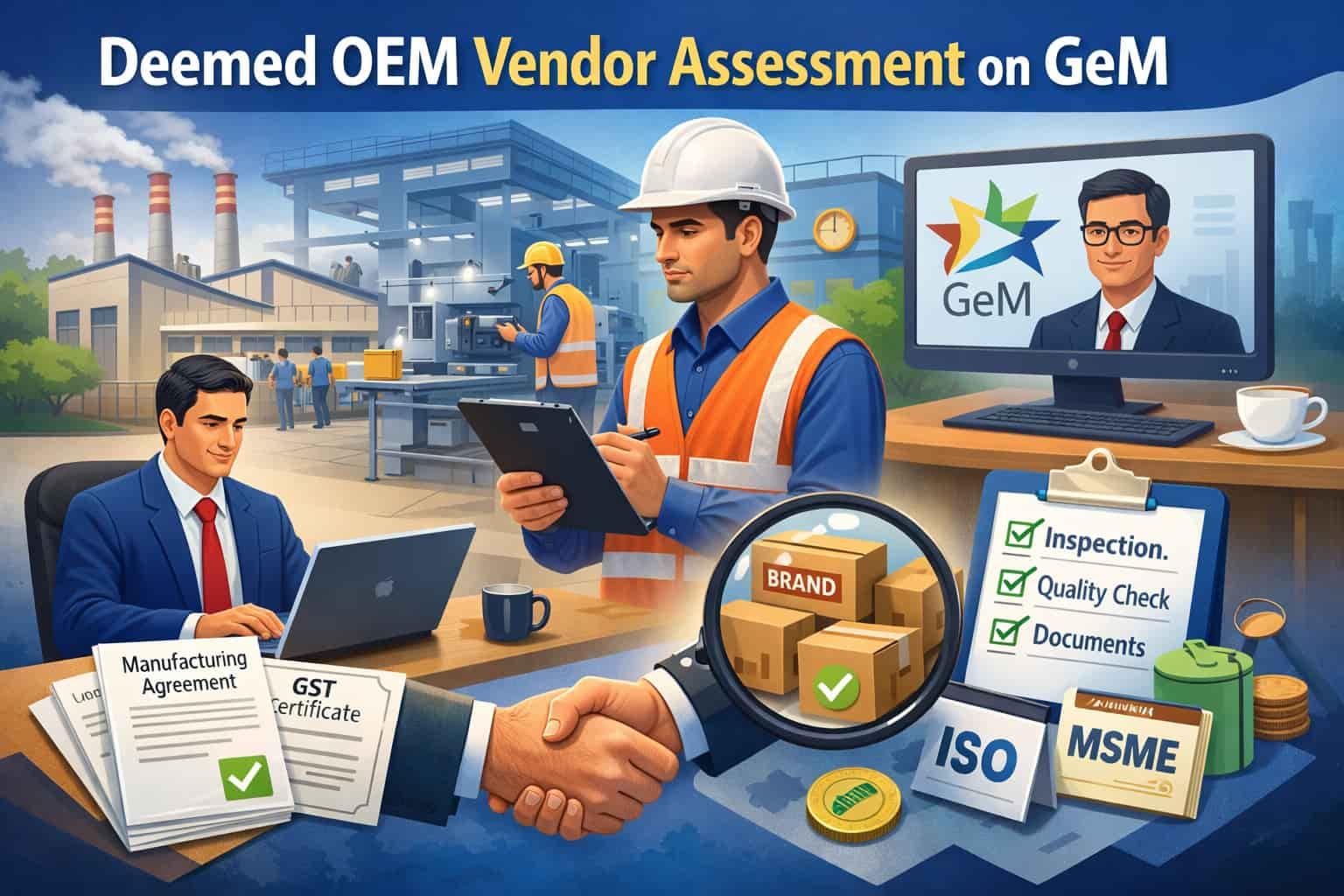
If you are planning to sell on the GeM portal as a manufacturer but do not own a factory, the term Deemed OEM Vendor Assessment may already be familiar to you. Many sellers get stuck at this stage because the process looks confusing and strict. In reality, it becomes easy once you understand why this assessment exists and how to prepare for it correctly.
Deemed OEM Vendor Assessment on GeM is designed for sellers who outsource manufacturing to third-party units but want to sell products under their own brand name. Since the government needs assurance about product quality, capacity, and compliance, GeM verifies such sellers through a structured assessment process.
Let us break this down in a clear and practical way.
What Does Deemed OEM Mean on GeM?
A Deemed OEM on GeM portal is a seller who does not own a manufacturing unit but gets products manufactured through a contract manufacturer. Even though the production is outsourced, the seller takes full responsibility for quality, branding, warranty, and after-sales support.
Because the actual manufacturing is not under the seller’s direct control, GeM introduces an additional verification layer called Deemed OEM Vendor Assessment. This ensures that both the brand owner and the manufacturing unit meet government procurement standards.
Why Deemed OEM Vendor Assessment Is Mandatory
GeM works with government buyers, so quality and accountability are non-negotiable. If any product fails or does not meet specifications, the liability falls on the seller. That is why GeM checks whether the seller has a genuine agreement with the manufacturer, whether the manufacturing unit has adequate infrastructure, and whether the seller has control over product quality.
Without completing the Deemed OEM Vendor Assessment, sellers cannot list products under Deemed OEM categories. This assessment acts as a gatekeeper to protect buyers and maintain trust in the GeM ecosystem.
How the Deemed OEM Vendor Assessment Process Works
The process starts after you select the Deemed OEM option while applying for vendor assessment on the GeM portal. You will be required to submit details of your company as well as the manufacturing unit you are associated with.
GeM appoints an authorized Quality Council of India agency or third-party assessor to conduct the evaluation. The assessment usually includes document verification and physical inspection of the manufacturing premises. In some cases, video inspection may also be done.
The assessor checks whether the manufacturing unit exists at the given address, whether machinery and manpower are available, and whether production capacity matches the declared product category. They also verify branding control, packaging responsibility, and traceability of products.
Key Documents Required for Deemed OEM Vendor Assessment
Documentation plays a major role in this assessment. Most rejections happen due to incomplete or incorrect documents. The brand owner needs to submit a valid manufacturing agreement or MoU with the contract manufacturer. This agreement should clearly mention product categories, branding rights, quality responsibility, and duration.
Other commonly required documents include GST certificates of both parties, factory license or Udyam registration of the manufacturer, authorization letter, and brand ownership proof. Product-specific certifications may also be required depending on the category.
All documents must be consistent in terms of company name, address, and signatures. Even small mismatches can delay approval.
Common Challenges Faced by Deemed OEM Sellers
Many sellers assume that vendor assessment is only about documents, but the physical verification part is equally important. If the manufacturing unit is not ready for inspection or lacks basic compliance, the assessment can fail.
Another common issue is weak or vague manufacturing agreements. If the agreement does not clearly show that the seller controls branding and quality, GeM may reject the application. Sellers also face problems when manufacturers are not cooperative during inspection or fail to provide required records.
Timely coordination between the seller and the manufacturer is crucial to avoid such problems.
How to Prepare for a Successful Deemed OEM Vendor Assessment
Preparation is the key to passing the assessment smoothly. Before applying, ensure that your manufacturing partner understands the GeM assessment process and is ready for inspection. All machinery, staff, and production records should be in place.
Documents should be reviewed carefully to ensure accuracy and completeness. Branding samples, packaging designs, and authorization letters should be ready if asked during inspection. When everything is aligned, the assessment becomes a formality rather than a hurdle.
Why Professional Support Helps in Deemed OEM Assessment
Deemed OEM Vendor Assessment involves technical understanding of GeM rules, documentation structure, and inspection expectations. A small mistake can lead to rejection or long delays. That is why many sellers prefer taking professional support to handle the process.
With proper guidance, you can avoid re-applications, reduce approval time, and start listing products faster on the GeM portal. Professional consultants also help in preparing compliant agreements and coordinating with assessors effectively.
Final Thoughts
Deemed OEM Vendor Assessment is not meant to block genuine sellers. It exists to ensure transparency, quality, and accountability in government procurement. If you understand the process and prepare in advance, clearing the assessment is completely achievable.
For sellers who want to build a long-term business on the GeM portal without manufacturing in-house, Deemed OEM registration is a powerful opportunity. The key is doing it the right way from the start.
 Italiano
 English
 Arabic
 French
 Spanish
 Portuguese
 Deutsch
 Turkish
 Dutch
Dutch
 Russian
 Romaian
 Portuguese (Brazil)
 Greek
Greek