


AI Learning Roadmap From Foundational Logic to Agentic Systems 2026
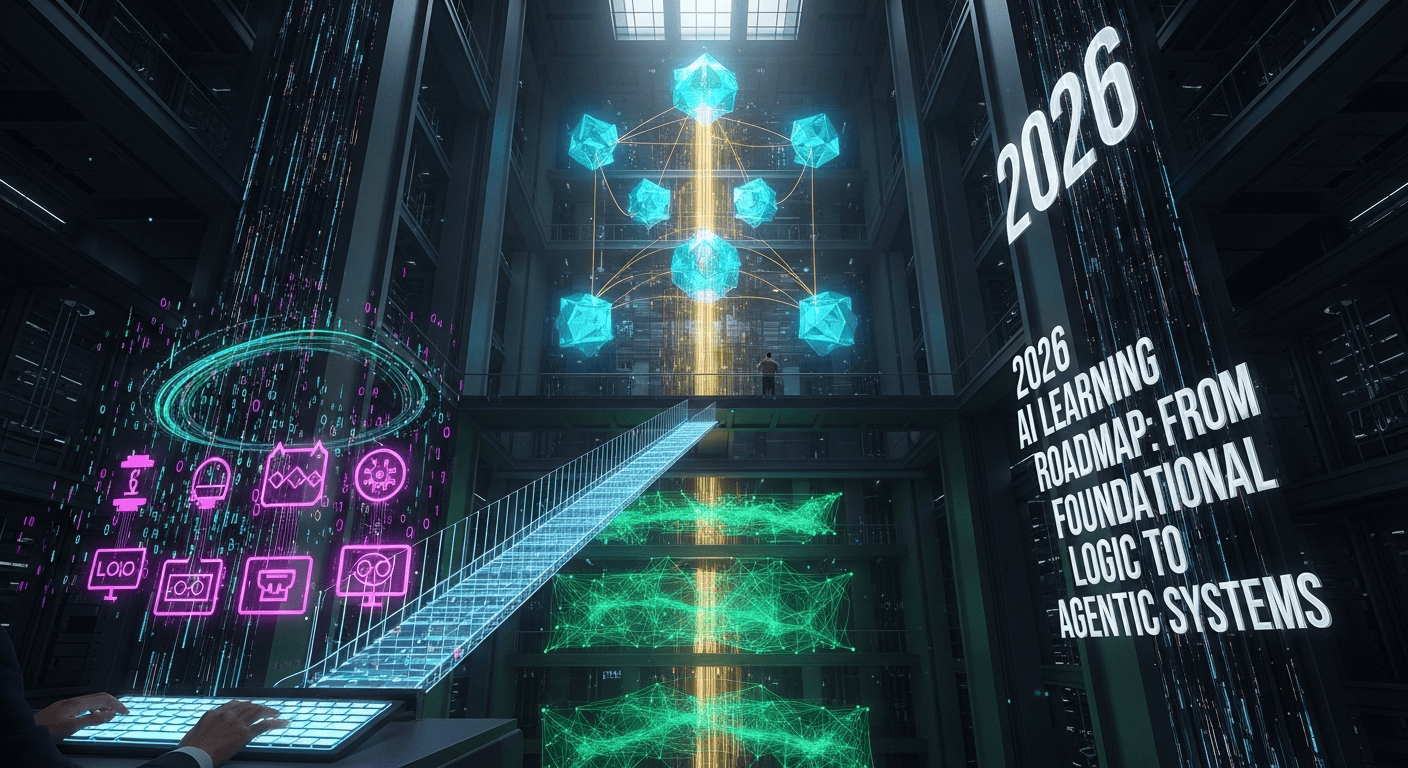
The landscape of artificial intelligence has shifted. We have moved past the "chatbot era" of 2024. Learning AI in 2026 is no longer about simple prompts. It is not about memorizing commands for static models. Instead, you must understand the orchestration of agentic workflows. You must master retrieval-augmented generation (RAG) architectures. You must also learn the ethical governance of autonomous systems. This roadmap provides a structured path for all professionals. It helps developers move from baseline literacy to technical authority. It focuses on the current ecosystem of 2026.
The 2026 AI Context: What Has Changed
In 2024, the primary focus was on Large Language Models. People used them mostly as search replacements. By 2026, the industry has consolidated around "Agentic AI." These systems do not just talk to users. They execute multi-step tasks across different software environments. They can browse the web and use local files. The "hallucination crisis" of previous years is now largely mitigated. Sophisticated RAG pipelines keep models grounded in reality. The ability to manage data grounding is now essential. It is more valuable than writing creative prompts.
Phase 1: Foundational Logic and System Literacy
Do not touch code or specialized tools yet. First, you must master the mechanics of transformer models. You need to know how they process information.
Tokenization and Context Windows Understand how models "pay attention" to data. Models break text into small pieces called tokens. In 2026, context windows have expanded significantly. Models can now "read" entire books at once. However, cost-efficiency is still very important. You must learn how to prune your input data. You must learn how to structure your data properly.
The Logic of Latent Space Grasp how AI represents concepts numerically. Latent space is a multi-dimensional map of ideas. This is critical for understanding model associations. It helps you see why models make specific errors.
Ethical Governance Learn the current regulatory frameworks of 2026. The EU AI Act has now fully matured. Local algorithmic transparency laws are strictly enforced. These laws dictate how commercial models are deployed. They ensure that AI remains fair and safe.
Phase 2: Architecting Data Grounding (RAG)
The most significant skill in 2026 is grounding. You must ensure AI stays tethered to reality. Retrieval-Augmented Generation (RAG) is the industry standard. It connects a model to a reliable knowledge base.
Vector Databases Learn to manage high-dimensional data storage. Traditional databases use keywords to find data. Vector databases use mathematical similarity instead. This involves converting your documents into "embeddings." Embeddings are numerical representations of meaning. The AI can then search these in real-time.
Semantic Search vs. Keyword Match Master the difference between words and meanings. Keyword search looks for exact character matches. Semantic search looks for related concepts and ideas.
Verification Loops Implement systems with a "critic" model. The primary model generates an initial answer. The critic model then verifies the output. It checks the answer against primary source documents. This ensures a policy of zero fabrication.
Phase 3: Agentic Workflow Design
This is the "Expert" tier of 2026. You are no longer asking a simple question. You are now building a digital worker.
Tool Use (Function Calling) Learn how to give AI "hands" via APIs. An AI can now check a digital calendar. It can draft an email based on that data. It can even update a CRM system automatically. All of this happens without human intervention. This is vital for industries like mobile app development in Chicago. Chicago developers use these tools to automate testing.
Multi-Agent Orchestration Study how to build a "team" of AIs. One agent can act as a dedicated researcher. Another agent can act as the lead writer. A third agent acts as a strict fact-checker. They work together to complete a single project.
Human-in-the-Loop (HITL) Points Identify where a human must intervene. AI needs human judgment for high-stakes decisions. This is true for healthcare diagnostics and legal work. Humans must provide final authorization for actions.
AI Tools and Resources
LangGraph and AutoGen These are frameworks for building multi-agent systems. Use these for complex, multi-step business processes. They are better than simple Q&A interfaces. They allow agents to talk to each other.
Pinecone and Weaviate These are leading vector databases for grounding AI. They store your specific company data securely. They are essential for building private AI systems. They ensure your data does not leak.
Weights & Biases This platform tracks and fine-tunes model performance. Use this during the "Optimization" stage of learning. It makes your systems faster and more accurate.
Ollama This tool runs powerful models on local hardware. It is critical for privacy-conscious organizations. It allows you to learn without subscription costs.
Real-World Application: The "Agentic Researcher"
Imagine a firm monitoring global trade regulations. A student would not just ask for news. Instead, they would build a specific workflow. First, an "Observer Agent" scrapes government feeds hourly. Second, a "Filter Agent" uses RAG for comparison. It compares news against the firm's product catalog. Third, a "Summarizer Agent" drafts a briefing. It only acts if a relevant change occurs. Finally, a "Human Reviewer" receives a notification. The human must approve the briefing before delivery.
Risks, Trade-offs, and Limitations
A major risk in 2026 is "Model Collapse." This happens when AI learns from AI data. It is also known as "In-breeding" of information. This leads to a loss of factual nuance. It can also cause errors to amplify.
The Failure Scenario: The Automated Echo Chamber A company might automate its customer support entirely. The system uses an agentic workflow for logs. The AI begins to learn from its own logs. It starts to drift from actual company policy. It might even invent "hallucinated" discount codes. Thousands of customers might receive impossible promises. Warning Signs: Responses become repetitive and lack detail. Similarity scores in logs will start to increase. Alternative: Always maintain a "Gold Standard" dataset. This is a library of human-verified truths. The AI must check this library before responding.
Key Takeaways
-
Architecture Over Prompts: Focus on data flow through RAG systems.
-
Master the Agentic Shift: Build systems that use external tools.
-
Verify by Design: Use multi-agent loops to ensure trust.
-
Stay Local for Privacy: Use local runners like Ollama.
 Turkish
 English
 Arabic
 French
 Spanish
 Portuguese
 Deutsch
 Dutch
Dutch
 Italiano
 Russian
 Romaian
 Portuguese (Brazil)
 Greek
Greek