


Shell Mold Casting Process
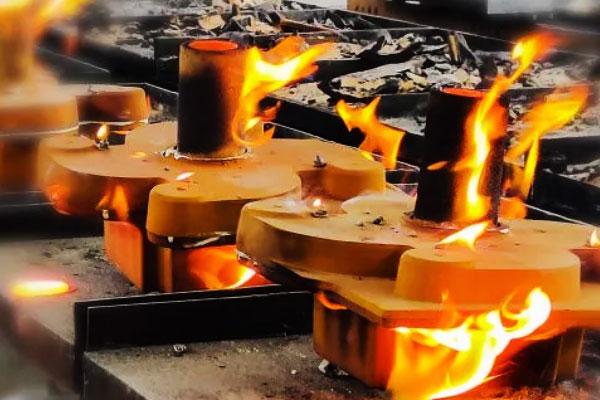
1. Introduction
Shell mold casting, a precision variant of sand casting, is a widely adopted metal casting process renowned for producing components with superior dimensional accuracy, fine surface finish, and consistent mechanical properties.
At its core, shell mold casting uses thermosetting resin-coated sand to form thin, rigid mold shells (3–10 mm thick) around a heated metal pattern.
The resin cures rapidly upon contact with the hot pattern, creating a durable mold that retains its shape during metal pouring and cooling.
This process is compatible with a wide range of metals, including ferrous alloys (carbon steel, stainless steel, cast iron) and non-ferrous alloys (aluminum, copper, magnesium), making it indispensable in automotive, aerospace, medical, and industrial machinery industries.
2. What is Shell Mold Casting?
Shell mold casting is a precision sand casting process that uses resin-coated sand (RCS) to fabricate thin, shell-like molds.
Unlike green sand casting (which uses moist clay-bonded sand), shell molds rely on thermosetting resin binders that cure via heat to form a rigid, self-supporting structure.
The process is characterized by:
- Thin mold shells (3–10 mm) for rapid cooling and reduced material consumption.
- Metal patterns (typically steel or cast iron) heated to 200–250°C to initiate resin curing.
- High dimensional accuracy (tolerances ±0.1–0.3 mm) and surface finish (Ra 1.6–6.3 μm).
- Compatibility with both ferrous and non-ferrous alloys, including high-temperature metals.
3. Step-by-Step Shell Mold Casting Process
The shell mold casting process consists of seven sequential stages, each critical to ensuring casting quality and consistency:
3.1 Pattern Preparation & Heating
- Pattern design: The metal pattern is machined to the desired casting shape, with allowances for shrinkage (1–3% depending on metal), draft angles (1–5° for easy shell removal), and gating/riser systems.
- Heating: The pattern is mounted on a pattern plate and heated in an oven or via electric heating elements to 200–250°C. Temperature uniformity is critical—variations >±10°C cause uneven resin curing and shell defects (e.g., thin spots, cracks).
3.2 Resin-Coated Sand Application
- Sand coating methods:
- Dump method: The heated pattern is inverted and dipped into a container of RCS, which adheres to the hot surface. Excess sand is removed by tapping or vibration.
- Blow method: RCS is blown onto the heated pattern via compressed air (0.2–0.4 MPa pressure), ensuring uniform coverage even for complex geometries (e.g., internal cavities, thin walls).
- Shell formation: The resin melts and cures within 5–30 seconds (depending on temperature and resin type), forming a shell of 3–10 mm thickness. Thicker shells (8–10 mm) are used for heavy castings; thinner shells (3–5 mm) for lightweight, precision parts.
3.3 Shell Removal & Assembly
- Shell removal: After curing, the shell is stripped from the pattern (thermal contraction of the pattern aids separation). The pattern is re-heated for the next cycle (cycle time: 1–3 minutes per shell half).
- Shell inspection: Visual inspection for cracks, thin spots, or missing detail. Defective shells are discarded to avoid casting flaws.
- Assembly: Two shell halves (cope and drag) are aligned and bonded using resin adhesive or clamped together. Cores (made from RCS or ceramic) are inserted to form internal cavities, with core prints ensuring proper positioning.
3.4 Mold Stabilization (Optional)
- For large or complex castings, the assembled shell is placed in a steel flask and backed with loose sand or ceramic beads to provide additional support during pouring. This prevents shell deformation under molten metal pressure.
3.5 Molten Metal Pouring
- Metal melting: The metal is melted in a furnace (electric arc, induction, or gas-fired) to the required pouring temperature (e.g., 1500–1650°C for carbon steel, 700–750°C for aluminum).
- Pouring: Molten metal is poured into the gating system (sprue, runner, gate) at a controlled rate (0.5–2 L/s) to avoid turbulence, which causes porosity and oxide inclusions. The thin shell promotes rapid filling (1–10 seconds for small parts).
- Solidification: The shell’s thin wall enables rapid, uniform cooling, refining the metal’s grain structure. Solidification time varies by metal and casting thickness (1–30 minutes).
3.6 Shell Removal & Cleaning
- Shell breakdown: After solidification, the brittle resin shell is removed via vibration (mechanical shakers), thermal shock (water or air cooling), or sandblasting. Resin binders decompose at high temperatures, making the shell easy to fragment.
- Cleaning: Remaining sand and debris are removed via shot blasting (steel or aluminum oxide grit), tumbling, or chemical cleaning. Gating, risers, and flash are trimmed via machining or grinding.
3.7 Finishing & Inspection
- Finishing: Optional processes include grinding (to improve surface finish), polishing (for cosmetic parts), and heat treatment (annealing, quenching) to enhance mechanical properties.
- Inspection: Dimensional measurement (coordinate measuring machine, CMM), visual inspection for surface defects, and non-destructive testing (NDT) for internal flaws (X-ray, ultrasonic, liquid penetrant testing).
4. Conclusion
Shell mold casting stands as a pivotal precision casting technology, bridging the gap between cost-effective green sand casting and ultra-precise investment casting.
Its ability to produce high-quality, dimensionally accurate components with consistent mechanical properties—across a wide range of metals—has solidified its role in automotive, aerospace, and industrial manufacturing.
While the process faces challenges (high tooling costs, resin emissions, size constraints), ongoing innovations in sustainable materials, automation, and additive manufacturing are addressing these limitations.
The integration of digital twins and 3D-printed patterns is reducing lead times and expanding applicability to low-volume production, while bio-based resins and sand recycling are improving environmental sustainability.
 Italiano
 English
 Arabic
 French
 Spanish
 Portuguese
 Deutsch
 Turkish
 Dutch
Dutch
 Russian
 Romaian
 Portuguese (Brazil)
 Greek
Greek