


Global Pea Starch Market Analysis
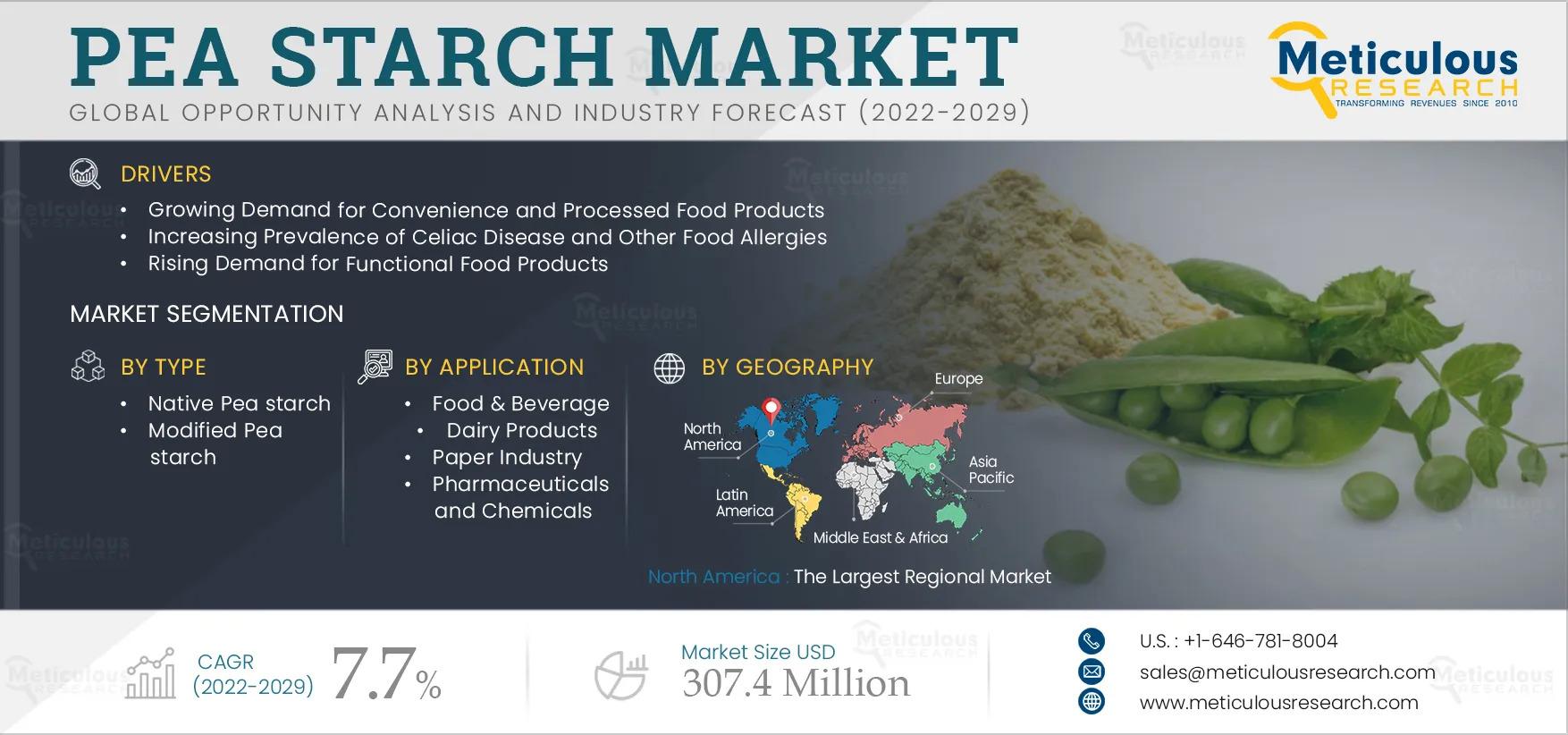
Meticulous Research®—a leading global market research company, published a research report titled Pea Starch Market by Nature (Conventional, Organic); Type (Modified, Native); Function (Thickener, Gelling, Binder, Stabilizer); Application (Food [Bakery, Dairy], Beverage, Pharmaceuticals, Paper Industry, Animal Feed)- Global Forecasts to 2029
According to this latest publication from Meticulous Research®, Strategic Market Positioning and Investment Opportunities in US Pea Starch Industry. The US pea starch market presents compelling growth opportunities for strategic investors and manufacturers, yet success requires careful navigation of competitive dynamics, product development choices, supply chain vulnerabilities, and realistic financial expectations. With the global market projected to reach $307.4 million by 2029 at a 7.7% compound annual growth rate, understanding these interconnected challenges is essential for C-suite decision-making.
Competitive Landscape and Market Share Potential
North America currently commands the largest share of the global pea starch market, driven by large-scale dry pea production, a well-established food and beverage industry, and rising consumer demand for clean-label products. The competitive environment features both established incumbents and emerging challengers, with major US players including Axiom Foods Inc., Dakota Dry Bean Inc., American Key Products Inc., Ingredion Incorporated, and Puris Proteins LLC having built significant market positions through vertical integration and processing capabilities. European manufacturers like Roquette Frères, Cosucra Groupe Warcoing, and Emsland Group have also established strong footholds through technological expertise and product innovation.
The market structure remains moderately competitive due to numerous regional and global players. The US advantage lies in proximity to major pea-producing regions, particularly Canada, which provides nearly half of North America's supply. Companies positioned near these agricultural hubs benefit from lower transportation costs and fresher raw materials. Market share acquisition depends heavily on application focus, with the food and beverage segment accounting for the largest share. Companies must choose between high-volume mainstream applications with intense competition or higher-margin pharmaceutical and pet food segments requiring specialized certifications.
Native Versus Modified Pea Starch: The Critical Production Decision
Perhaps the most consequential strategic choice facing pea starch manufacturers is whether to invest in native or modified production capabilities. Native pea starch is projected to register the highest growth rate during the forecast period, driven by powerful consumer trends toward sustainable, natural foods and clean-label products. Its functionality in non-GMO, gluten-free, grain-free, vegan, and allergen-friendly applications positions it perfectly for current market demand.
The investment case for native pea starch centers on lower processing complexity and capital requirements compared to modified varieties. Production primarily involves wet separation or dry fractionation techniques that extract starch without extensive chemical treatment, translating to faster time-to-market and lower technical risk. Additionally, native starch commands premium pricing in organic and clean-label segments where consumers willingly pay more for minimally processed ingredients.
Modified pea starch, while currently representing a smaller market segment, is experiencing rapid growth with the fastest-growing modified segment showing a remarkable 23% CAGR, far exceeding the overall market growth rate. This explosive expansion reflects manufacturers' need for plant-based functional ingredients that can replace chemically-based starches. Modified varieties undergo treatments to enhance stability at high temperatures, improve viscosity control, increase acid resistance, and extend shelf life. Many successful players are adopting hybrid strategies, developing native starch capabilities initially while building technical expertise for modified products over time.
Mitigating Supply Chain Risks from Declining Pea Production
The pea starch industry faces a fundamental vulnerability: declining dry pea production threatens to constrain market growth precisely as demand accelerates. Recent data reveals concerning trends, with US frozen pea stocks dropping 28% in July 2025 compared to the previous year, reaching levels up to 42% lower than any year since 2020. Through the first seven months of 2025, frozen pea inventories consistently trailed historical averages, with March and April volumes more than 30% below 2024 levels.
Multiple factors drive this production decline including climate volatility, labor shortages during critical planting and harvest periods, and farmers increasingly viewing peas as less economically attractive compared to alternative crops like corn and soybeans. Forward-thinking companies are implementing several mitigation strategies. Direct contracting with pea farmers provides supply certainty through multi-year agreements that lock in volumes and pricing. Some manufacturers are investing in agricultural extension programs that provide farmers with improved seeds, technical support, and guaranteed purchase commitments.
Vertical integration represents a more capital-intensive but highly effective approach, with companies like Puris investing in their own agricultural operations, directly controlling significant acreage and processing facilities. Geographic diversification of sourcing mitigates regional production risks, though quality standards vary significantly across regions. Technology investments in precision agriculture techniques, improved irrigation systems, and pest-resistant pea varieties can boost yields and reliability.
ROI Timeline and Financial Modeling for Market Entry
Translating the 7.7% market CAGR into realistic return-on-investment timelines requires sophisticated financial modeling. Capital investment requirements vary dramatically based on production approach. A basic native pea starch facility requires $15-25 million in processing equipment, quality control systems, and initial working capital. Modified starch capabilities add $10-15 million for chemical processing units and specialized storage.
Working capital requirements often exceed initial expectations, with pea starch manufacturers typically operating on 60-90 day payment terms from customers while needing to maintain 90-120 days of inventory given agricultural seasonality. This creates a significant cash conversion cycle requiring $5-10 million in working capital for mid-sized operations.
Revenue ramps require patience, with year one typically generating 20-30% of designed capacity as companies qualify products with customers. Full capacity utilization typically arrives in years three to four. Gross margins vary significantly by market segment, with commodity-grade native starch achieving 25-35% margins, specialized food-grade products commanding 35-45%, and premium organic products reaching 45-55% margins.
Break-even analysis reveals that most pea starch operations require 3-4 years to reach cash flow positivity, with typical paths involving $15-20 million in cumulative cash burn through year three and achieving payback of initial investments in years six to eight. Internal rate of return calculations suggest well-executed pea starch ventures can generate 15-20% IRRs over ten-year holding periods, attractive compared to many food ingredient businesses.
The pea starch market represents a strategically important growth opportunity with strong fundamentals driven by plant-based trends, but success requires careful attention to supply chain security, production technology choices, and patient capital deployment. Companies with existing food ingredient operations, established customer relationships, and transferable technical capabilities are best positioned to capture value in this expanding market.
Key Market Players: The global pea starch market features a diverse competitive landscape with prominent players including US-based companies such as Axiom Foods Inc., Dakota Dry Bean Inc., American Key Products Inc., Ingredion Incorporated, and Puris Proteins LLC, alongside European leaders like Roquette Frères (France), Cosucra Groupe Warcoing SA (Belgium), Emsland Group (Germany), and Meelunie B.V. (Netherlands). Asian manufacturers including Yantai Shuangta Food Co., LTD and Shandong Jianyuan Foods Co., Ltd. from China are also gaining prominence, while other notable players include Vestkorn Milling AS (Norway), NutriPea LP (Canada), Agridient B.V. (Netherlands), Aminola B.V. (Netherlands), and Ebro Foods S.A. (Spain), collectively driving innovation and competition across native and modified pea starch segments.
Download PDF Brochure: https://www.meticulousresearch.com/download-sample-report/cp_id=5389
Contact Us:
Meticulous Research®
Email- sales@meticulousresearch.com
Contact Sales- +1-646-781-8004
Connect with us on LinkedIn- https://www.linkedin.com/company/meticulous-research
 Portuguese (Brazil)
 English
 Arabic
 French
 Spanish
 Portuguese
 Deutsch
 Turkish
 Dutch
Dutch
 Italiano
 Russian
 Romaian
 Greek
Greek