


Beam Deflection and Beam Steering Using Acousto-Optic Modulators (AOMs)
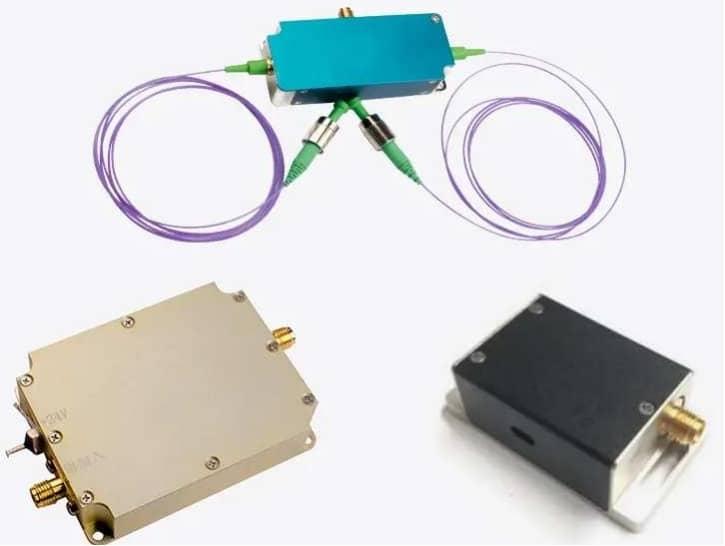
Abstract: While commonly known for intensity modulation, Acousto-Optic Modulators (AOMs) are also powerful tools for precise, rapid, and non-mechanical control of laser beam direction. This article explains the principles of Bragg diffraction-based beam deflection, explores the design of specialized Acousto-Optic Deflectors (AODs), and discusses their key applications and performance characteristics.
1. From Modulation to Deflection
At its core, an AOM operates by creating a traveling refractive index grating within a crystal (like TeO₂ or fused silica) via an acoustic wave generated by a piezoelectric transducer. When a laser beam interacts with this moving grating under the Bragg condition, it is diffracted, experiencing a frequency shift equal to the acoustic drive frequency (f_acoustic).
For a fixed acoustic frequency, this results in a single deflected "1st order" beam at a specific angle. Beam deflection is achieved by simply varying this acoustic frequency. As f_acoustic changes, the period of the acoustic grating (Λ = v_acoustic / f_acoustic) changes, thereby altering the angle that satisfies the Bragg condition.
2. The Deflection Principle: Angle vs. Frequency
The fundamental equation governing the diffraction angle (θ_d) for a Bragg-regime AOM is:
sin(θ_d) ≈ λ * f_acoustic / (2 * n * v_acoustic)
where:
λ = Optical wavelength
n = Refractive index of the medium
v_acoustic = Speed of sound in the medium
For small angles, the deflection is approximately linear with the acoustic frequency:
Δθ ∝ Δf_acoustic
This linear relationship is the cornerstone of AOD design. By driving the AOM with a chirped or frequency-agile RF signal, the diffracted beam can be scanned rapidly across a range of angles without any moving parts.
3. Key Performance Metrics for AODs
Scan Range (Resolution Spots): The total angular range divided by the beam's diffraction-limited spot size. It defines how many distinct, resolvable points the deflector can address. Number of Resolution Spots (N) ≈ τ * Δf_acoustic, where τ is the acoustic transit time across the optical beam.
Scan Speed & Access Time: The speed is virtually unlimited (MHz rates), but the access time—the time to switch from one spot to another—is limited by the acoustic transit time (typically microseconds).
Efficiency & Aperture: Diffraction efficiency must remain high across the entire frequency band. The optical aperture must be large enough to not truncate the scanning beam, which sets a trade-off between resolution (large aperture, slow access time) and speed (small aperture, fast access time).
4. Applications of AODs
Laser Scanning Microscopy: Used in confocal and multiphoton microscopes for ultra-fast random-access or resonant scanning of samples.
Laser Direct Writing & Lithography: Precisely steering beams for machining, patterning, or maskless lithography.
Optical Storage & Communications: Rapid addressing of memory locations or switching between communication channels.
Laser Displays: Forming the core of high-speed, green laser projection systems.
5. Conclusion
Acousto-Optic Deflectors offer a unique combination of random-access capability, microsecond switching speeds, and high precision. While their scan range is more limited than mechanical galvanometers, their lack of inertia and wear makes them indispensable for applications demanding the highest speed and reliability in beam positioning.
 Turkish
 English
 Arabic
 French
 Spanish
 Portuguese
 Deutsch
 Dutch
Dutch
 Italiano
 Russian
 Romaian
 Portuguese (Brazil)
 Greek
Greek