Unwanted noise—whether it’s traffic from the street, a neighbor’s TV, or echoes in an empty room—can disrupt comfort and focus. For homeowners, renters, and business owners alike, fabric wall panels are often touted as a “soundproofing” solution. But do they truly block noise? This guide breaks down their acoustic performance, how they work, and when to use them for better sound control.
Before diving into fabric wall panels, it’s critical to clarify two key terms—they’re often confused, but they serve distinct purposes:
- Soundproofing: Blocks sound from entering or exiting a space (e.g., keeping street noise out of a bedroom). It requires dense, mass-rich materials (like drywall, lead, or concrete) to stop sound waves from passing through walls.
- Sound absorption: Reduces echoes and reverberation (bouncy noise) inside a space (e.g., making a home theater feel less “empty” or a conference room easier to hear in). It uses porous materials that trap sound waves instead of letting them bounce off hard surfaces (like walls, floors, or ceilings).
Fabric wall panels excel at sound absorption, not full soundproofing. They won’t completely block loud external noise, but they drastically improve a room’s acoustic comfort.
Fabric wall panels work because of their layered design, which is engineered to trap sound:
- Core material: Most panels have a porous core (e.g., fiberglass, mineral wool, or foam). These materials have tiny air pockets that catch sound waves, converting the sound energy into minimal heat (instead of letting it bounce back as echo).
- Fabric covering: The outer fabric (e.g., velvet, linen, polyester) is breathable, allowing sound waves to pass through to the core. Tighter weaves (like polyester blends) absorb mid-range sounds (voices, TV), while looser weaves (like linen) handle higher frequencies (birdsong, sirens).
- Installation: Panels are mounted slightly off the wall (a 1–2 inch gap) or directly attached. The gap creates an “air cavity” that enhances absorption, especially for lower frequencies (bass, traffic rumble).
Fabric wall panels won’t turn a noisy room into a soundproofed sanctuary, but they deliver measurable improvements:
- Reduced echoes: In large, hard-surfaced spaces (e.g., open-concept living rooms, offices with glass walls), panels cut down on “bouncy” noise. A home theater with fabric panels, for example, will feel more immersive—dialogue is clearer, and music sounds warmer.
- Lower reverberation time: This is how long sound lingers in a room (measured in seconds). Fabric panels can reduce reverberation from 2–3 seconds (echoey) to 0.5–1 second (comfortable) in a 200 sq. ft. room.
- Muffled mid/high frequencies: They soften sounds like voices, kids playing, or kitchen clatter—making the space feel quieter, even if external noise still seeps in.
For context: A fabric panel-covered wall (covering 20–30% of the total wall area) will make a room feel “calmer” but won’t block a loud party next door—for that, you’d need to add mass to the wall (e.g., extra drywall) plus fabric panels for absorption.
To get the most out of fabric wall panels:
- Cover 20–30% of wall space: Focus on “first reflection points”—areas where sound bounces first (e.g., opposite a TV or speaker, above a couch).
- Choose the right core: Fiberglass or mineral wool cores absorb more sound than foam (great for home theaters/ offices); foam cores are cheaper and lighter (ideal for renters).
- Pair with other solutions: Combine panels with thick rugs (absorb floor noise) and heavy curtains (block some external sound) for a well-rounded acoustic setup.
Fabric wall panels are not a “magic bullet” for soundproofing, but they are one of the most stylish and effective ways to improve a room’s acoustics by reducing echoes, softening noise, and enhancing comfort. They’re perfect for anyone who wants to make their home, office, or commercial space feel quieter without sacrificing design. For a solution that blends top-tier sound absorption with durability and modern style,
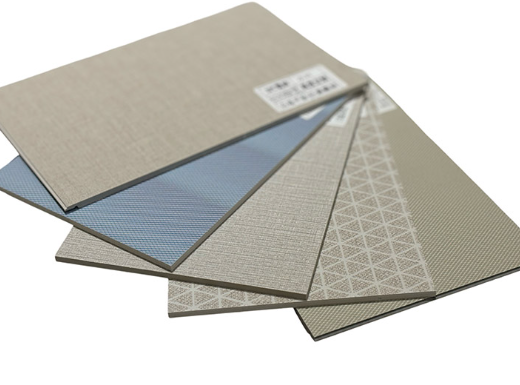
choose Chongqing Huigong’s Fabric Grain SPC Wall Panels—we
feature a high-performance acoustic core wrapped in a realistic fabric-grain finish, balancing functional noise control with the warm, textured look of fabric, ideal for both residential and commercial spaces.



 Romaian
 English
 Arabic
 French
 Spanish
 Portuguese
 Deutsch
 Turkish
 Dutch
Dutch
 Italiano
 Russian
 Portuguese (Brazil)
 Greek
Greek